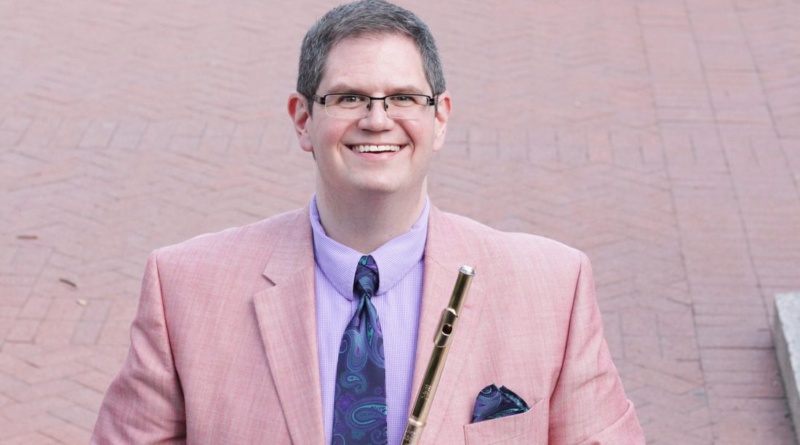
Timothy Hagen Artist Interview
Timothy Hagen is an internationally prize-winning flutist and composer. Currently Assistant Professor of Flute and Coordinator of Woodwinds at Central Washington University and a member of the tonebase flute faculty, he is also Principal Flute of the Dubuque and Missouri Symphonies and has performed with orchestras across the United States.
Your career path has been extraordinarily broad with a portfolio that encompasses performance, teaching, and composition. Is this what you imagined for yourself when you were a student, or have there been some surprises along the way?
Honestly, I had no concept of what a career as a working musician would look like when I was a student. I knew people played in orchestras and other professional ensembles, and I knew people taught privately or for institutions, but I had no vision of how I might fit these pieces together. My career came together piece by piece, and there were plenty of surprises.
When I was about 7 weeks away from graduating with my bachelor’s degree from the University of North Carolina School of the Arts, I learned that I had been accepted to precisely zero graduate programs. Because “get a master’s” was the only goal I had beyond college, I had to scramble to figure out what to do after commencement. Fortunately, UNCSA had an incredible career services office, and Eva Toia, the head of that office, sat down with me to look at options. She strongly recommended I apply for an internship at Lincoln Center Education, which had just begun a partnership with UNCSA. I did, and I was fortunate to receive one of four spots, so it was off to New York City for nine months, where I learned LCE’s framework of aesthetic education and the fundamentals of teaching and teaching artistry. There were two big surprises here: I loved teaching, and I was good at it.
I ended up at the University of Southern California for my master’s the next year, which was exactly where I needed to be. Jim Walker was an ideal mentor for me. He not only helped me elevate my flute playing, but he was also in favor of “extracurricular activities” that would end up becoming staples of my career. For example, he was very encouraging of my work as a teaching artist for the LA Phil, a position for which my LCE experience prepared me.
Jim has the gift of being able to look inside people and see who they are at their core. When my second master’s recital was coming up, he pushed me to write a piece for it, even though I had never shared with him that I had been dabbling in composition ever since I was in high school. The piece I wrote—Pull for alto flute, hand drum, and antiphonal flute—was well received by Jim and my colleagues, who started asking me to write music for them. Jim thought that I should write a “rock and roll, Ian Clarke” style piece for solo flute, as he put it. That led to Blowout, which has become my most popular piece. Flutists all over the world play it now, and that’s wild to me—I wrote some notes down 17 years ago, and through those little dots on a page, I have a connection to musicians and audiences I may never even meet. That has been a wonderful surprise in my life and profound example of how our actions in life can have ripple effects that go far and last long.
My studies with Jim at USC and Colburn after that bought me enough time to drum up a good amount of freelance teaching and playing in LA, while more people started asking me to write music for them. That’s how my career came together: I had a few things I loved doing, I was good at them, and I just started saying yes to as many opportunities as I could, even if I had insecurity or uncertainty that I could do the work well. This is why I believe that saying yes to whatever opportunity is in front of you is a key ingredient of success.
Studio Teaching
Congratulations on your new role as Assistant Professor of Flute and Coordinator of the Woodwind Area at Central Washington University! What’s most important to you when walking into a new studio for the first time?
Having been in this situation a number of times as an interim or visiting professor, the first priority is always to build community through trust. I look at a high-functioning studio as something like a caring family: it works best when we can trust that we will continually support, encourage, and inspire each other. As community leader, I have to set the example. I am interested in my students as whole people, not just flutists. Once students know I’m invested in their wellbeing far beyond their flute playing, they trust my feedback and guidance, which catalyzes their artistic evolution.
Part of my job is also to set a tone of dignity, respect, and compassion for all studio members, regardless of background or experience. Many studio environments become negatively competitive, and instead of focusing on their own growth, students get caught up in being “better” than their peers. The only person anyone should even consider competing with is yesterday’s version of themselves. When you hear one of your peers do something astonishing that you can’t do, the first word you think should be “yet,” as in, “I can’t do that yet.” The fact that someone else learned to do it means that odds are you can learn to do it too with the right kind of work done long enough. Rather than pushing students to try and “beat” each other, I find this mindset produces students who value curiosity and gratitude, setting the stage for a lifetime of growth. I call this kind of artist a “citizen artist,” someone who understands that producing great art is not antithetical to human connection but rather that art facilitates connection, which facilitates art, which facilitates connection….
How would you describe your teaching philosophy? What do you want your students to take away from their lessons and from their time with you?
I often find myself telling students, “I don’t care if you turn your flute into a lamp when we’re done,” and I really mean that. While I am invested in helping every student realize their potential on the flute to the greatest degree possible, it is even more important to me that students realize their potential as humans living the lives they want to live. This approach was instilled in me by two of my teachers, Jim Walker and Marianne Gedigian. The flute is simply a vehicle for teaching bigger lessons, namely that students are capable of intense critical thinking, problem solving, and resilience.
“Hmm, my third octave E isn’t speaking right away.” That’s a problem.
“I wonder why.” That’s opening the door to the kind of critical thought that helps develop hypotheses. Some of them will work; some won’t.
When a hypothesis does work: “I figured out a solution! Can I repeat it? Can I make it part of me?”
When it doesn’t: “I’m going to keep brainstorming and trying solutions until I find one that sticks.” In both cases, these responses reflect the resilience required to find long-lasting solutions.
If a student can understand and embrace the power in this approach, they can learn virtually anything and make vital contributions in any field they choose. If a student takes what they learn in the studio and uses it to become a great electrician, travel agent, writer, city council member, or anything else, that’s a win for everyone. I don’t believe in wasted talent. Those who follow professional paths outside music almost always take their love for music with them, becoming dedicated patrons and finding ways to continue making music on their own terms.
What advice can you give to advancing students who are considering studying music in college?
Being a professional musician is hard. The amount of work it takes to prepare for either the working world or graduate school over the course of an undergraduate degree is mammoth, comparable to the amount of work students have to do to prepare for careers in medicine or law. And the degree just lays a foundation. Once through with formal education, education and therapy majors become teachers and therapists and move to working environments in the classroom or clinic that only increase in challenge and complexity over time. Performance majors and BA’s learn that jobs that pay a living wage are few and far between, which is why so many stitch together portfolio careers that are highly creative and enjoyable but also exhausting and financially insecure.
That’s a peek into the challenges of a career in music. As a professor, it is unethical for me to accept and encourage students who don’t understand this background. Those who will ultimately be successful are the ones who will hang in there and do really tough, intelligent work for much longer than anyone really wants to do that kind of work, until they get what they want on the other side of that work. Success in music is achievable for anyone who wants it that badly.
And if you don’t want it that badly, that’s fine! Figure out what it is in life you do want, and go pursue that. You can participate in music on your own terms along the way.
Finding Balance
You clearly love what you do, but music careers can demand so much time and energy. How do you think about balance between work and life? What wisdom can you share about sustaining a healthy, fulfilling career over the long term?
In an ideal world, it is important to plan breaks, where we can rest and recharge between obligations. In the real world, sometimes this is possible, sometimes not. It is vital to take advantage of the times it is possible. I just had a much-needed 6-week break after a year and a half of pretty much continuous work. I would have preferred a break sooner, even if that break was shorter, but that just wasn’t in the cards—and to be clear, the work that kept me from taking a break was very rewarding.
But no matter how much you love your work, you are not your work, and breaks are necessary. I often talk about the importance of scheduling time to take care of yourself with undergraduate students. This generation of students hasn’t been allowed to be as independent in high school as my generation was, so many arrive at college with little in the way of time management skills. I work with these students to create a weekly schedule that accounts for every minute and starts with sleep, which is non-negotiable. Then, we record their standing obligations, like classes. Next comes scheduling food, then practice, homework, socializing, clubs, hobbies, etc.
The goal is to help students understand that basic human needs have to be prioritized before any effective work can happen. I can’t count how many times I’ve had a student fall apart in the middle of their first term at school because they aren’t sleeping and eating well. When our habits prioritize our wellbeing, we’re giving ourselves a great launchpad to do our best in our pursuits and relationships. Learning this lesson as a student pays dividends later in life.
Outside of taking care of yourself as a human first, I think pursuing work you care about deeply is key to sustaining a long, healthy career. During the stretches of my own life when society has forced me to choose between paying bills and resting, I’ve found that my own passion and curiosity for the work helps get me through.
Approach to Performing
As a performer, what is your approach to programming and connecting with an audience? What do you hope listeners feel when they experience your playing?
I love this question. It’s less important to me what an audience feels than it is that they feel something—hopefully many somethings. That’s the whole point of music and art in general: it’s expressive. It’s supposed to make us feel. Of course, I want to play correct notes and rhythms and play in tune, and all that, but the way I look at it, failing to do these things distracts the audience from what I call their own imagination journeys. Doing these things lays a good foundation for performance, but these nuts and bolts don’t add up to emotion in a listener. More is required—a thorough understanding of style, thoughtful interpretation, and deep conviction—to do that.
This is why when I am in charge of programming, I choose music that makes me feel, music I can use to compel the audience to take their own journeys of feeling and imagination while they listen. The performance is really about the audience’s experience, and while the performer is necessary, in my mind I’m really a conduit for the music and the emotions that come with it.
This mindset makes me aware I have a platform anytime I’m responsible for programming. Which compositional voices I choose to amplify is my prerogative, which is why I am constantly searching for great music by composers from underrepresented backgrounds: Black and brown, LGBTQIA+, and women artists, for example. Performance careers aren’t infinite. I want to spend the limited time I have helping composers who may have been unfairly excluded in the past to be heard now.
Upcoming Projects
Do you have any upcoming performance or composition projects you’re particularly looking forward to?
I’m really looking forward to my first faculty recital at Central Washington, scheduled for October 29. Because it’s Halloween week, I’m calling the program Tricks and Treats. A wide variety of styles will be represented in music by Mary D. Watkins, Mieczyslaw Weinberg, Gaetano Donizetti, André Jolivet, Kenji Bunch, and Jasmine Barnes. My colleague Nik Caoile, CWU’s fantastic orchestra director, offered to play piano, as he did for my interview recital, so this really feels like a warm, welcoming moment. I hope we’re able to take the show on the road in the Pacific Northwest.
Another performance I’m looking forward to is part of a residency at Denison University in Ohio in February 2026. My friend Zachery Meier teaches composition there, and he invited me. The performance will weave together music by LGBTQIA+ composers, including Zachery and me, with stories from my life that I think will resonate with listeners. I hope everyone in that space leaves feeling more connected to each other than we enter.
I’m taking a brief hiatus from composition right now. My flute concerto, which I premiered as soloist with the Dubuque Symphony in February 2025, was a very heavy lift, and I need some time away from writing to let those batteries recharge. That said, I am working on the flute/piano version of the concerto to make it accessible to more performers and audiences. I’m also looking forward to a commission celebrating the Elgin Youth Symphony Flute Choir’s 50th anniversary to be premiered in Spring 2026.
I’m grateful that my musician colleagues and our audience in Dubuque loved the flute concerto, and I’m now in preliminary talks about composing another work for them. The concerto doesn’t use winds or brass, so they want the new work to incorporate the full orchestra, which makes me very excited. One of my violin colleagues there has also inquired about a violin concerto, and that would be great fun to write.
Impact
You’ve spoken about using the arts as a platform. What role do you believe musicians have in advocacy—whether for the arts themselves or for broader societal issues?
This is one of my favorite subjects to talk about, or rant about, depending on whom you ask. A lot of classical musicians look at themselves as re-creators. Their job is to reproduce in real time the music that was actually created by someone else. My view is that this is an abandonment of our agency as artists. A score on the page is at best unfinished music, which is only truly finished in the moment musicians play it and listeners hear it. Performers re-create nothing; instead, we finish the creation of the composer. Furthermore, the way we choose to play something is crucial to whether the audience has the experience we intend. Effective performance sets up expectations in the listener’s ear and then dashes those expectations, surprising the listener and keeping them engaged. The skilled musician has a deep understanding of the tools at their disposal for this purpose—pacing, color, silence, vibrato, articulation, and so on—and can choose when and how to use them appropriately.
Beyond the stage, we have a lot of agency when it comes to programming, and often, the battle for the heart and imagination for the listener is won or lost here. What are you choosing to play? Why are you choosing to play it? What do you want to induce in your audience? Will this music do that? If so, in what order should you play the pieces to maximize the effect on the listener? This approach makes all musicians effective proponents for the arts and the empathy and connection that flow from them. Our world sorely needs these things.
Finally, it’s important for musicians to be tuned in to their personal values. Justice and belonging for all people is important to me, which is why I am committed to programming underrepresented voices: I want anyone who shows up to hear me play be able to hear something of themselves and their experience in the music. I would encourage any musician programming performances to look for opportunities to use music to engage audiences around issues that matter to them.
For young flutists, what are some meaningful ways they can begin to think of themselves not only as musicians, but as advocates and contributors to their communities?
Anyone who plays music is a musician, period. Student, hobbyist, and professional are labels we place on musicians that really only reflect the relationship between the life of the musician and the music they play. These labels have nothing to do with the quality of music-making that’s happening. So that’s first: if you play an instrument or sing, you are a musician. Accept that. Giving yourself that license will make the lessons you learn from engaging in the creative process even more powerful.
Advocacy and contributing to your community come when you interact with other people, so look for opportunities to play in public. You can play just for the joy of it, which makes you a proponent of joy, or you can use music as I talked about earlier, to engage people around issues that are meaningful to you. Benefit concerts that support particular causes are a popular example of this approach but are certainly not the only examples.
Teaching is another wonderful way to contribute to your community. One evergreen piece of advice for young musicians is to find someone who knows less than you about music but wants to grow. Teach that person. They will grow toward their own goals while you sharpen your teaching skills.
There is no minimum age requirement for any of this. Keep your eyes open for opportunities to share what’s inside you, and you’ll start seeing them everywhere.
Praised for his "technical virtuosity and musical sensitivity" (NewMusicBox) and “real flair” (The Well-Tempered Ear), flutist Timothy Hagen is a laureate of multiple national and international competitions, including the Myrna Brown Artist Competition and Australian International Flute Competition. He is Principal Flute of the Dubuque Symphony and Missouri Symphony, and has performed with professional ensembles across the country, including the Minnesota Orchestra, Milwaukee Symphony, Oregon Symphony, Grant Park Orchestra, Kalamazoo Symphony, San Antonio Symphony, and Dallas Wind Symphony. His award-winning compositions are performed by musicians throughout North America and Europe, and his scholarly writing has appeared in the journals of the National Flute Association (USA) and British Flute Society.
Hagen is Assistant Professor of Flute and Coordinator of Woodwinds at Central Washington University. He is also an instructor for the online conservatory tonebase, where his courses can be found alongside those by faculty members from top musical institutions such as the Juilliard School, Rice University, University of Michigan, Peabody Institute, and the symphony orchestras of Pittsburgh, St. Louis, and Detroit. Hagen has previously taught at Clarke University, Austin Peay State University, Central Michigan University, the University of North Carolina-Greensboro, University of Wisconsin-Whitewater, Oklahoma State University, The University of Texas-Austin, and Brookhaven College, as well as in partnerships with the Los Angeles Philharmonic, Lincoln Center Education, and Dallas Symphony. He completed his studies at the UNC School of the Arts, University of Southern California, Colburn School, and UT-Austin, and his teachers include Marianne Gedigian, Jim Walker, Philip Dunigan, Renée Siebert, Tadeu Coelho, Chelsea Czuchra, Felicia McNaught, and Tina Ballard.