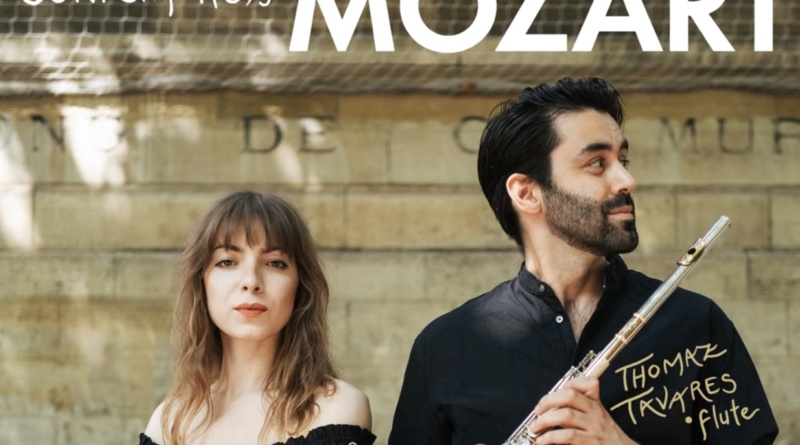
Brazilian flutist Thomaz Tavares & Lithuanian pianist Ruta Kuzmickas join forces & release New Album: Mozart K. 379
Brazilian flutist Thomaz Tavares and Lithuanian pianist Ruta Kuzmickas offer a refined and deeply musical collaboration on their newly released Mozart album, centered around the radiant Sonata in G major, K. 379. From the opening measures, the duo establishes an unmistakable artistic rapport. There is an effortless balance between lyricism and structure, with each phrase shaped collaboratively rather than competitively. The beautiful synergy between the two artists is immediately apparent—this is chamber music in its truest form, where dialogue and mutual listening guide every nuance.
Tavares brings a truly gorgeous sound to the recording. His tone is warm, supple, and expressive, floating with remarkable ease above the keyboard textures. He shapes lines with a singer’s sensitivity, allowing Mozart’s melodies to bloom naturally without excess affectation. Kuzmickas proves an equally compelling partner, offering expert artistry at every turn. Her playing is marked by a sublime touch and masterful technique, providing both harmonic grounding and sparkling elegance. Together, they craft a performance that feels organic and deeply felt, revealing not only the brilliance of Wolfgang Amadeus Mozart, but also the unmistakable chemistry of two musicians who listen as beautifully as they play. This is a poised and captivating Mozart release that celebrates both individuality and unity in chamber music.
The opening Adagio sets an intimate and reflective tone, and the duo approaches it with remarkable poise. The spacious pacing allows every phrase to breathe, highlighting the conversational nature of the writing. Tavares’ flute line unfolds with vocal warmth, each note shaped with care and intention. His expressive shading never feels indulgent; instead, it invites the listener into Mozart’s lyrical world with sincerity. Beneath him, Kuzmickas crafts a delicately woven harmonic tapestry. Her touch is luminous and controlled, allowing the piano to sing without overpowering the flute. The movement feels suspended in time, drawing the listener into a state of calm attentiveness that sets up the brilliance of what follows.
The Allegro bursts forth with vitality and clarity, offering a striking contrast to the introspective opening. Here, the duo’s synergy becomes especially evident. The interplay between flute and piano is lively and finely articulated, with both players exchanging gestures with buoyant energy. Tavares’ articulation is crisp yet never dry, maintaining a buoyant elegance that keeps the music dancing forward. Kuzmickas matches him with sparkling precision, her fingerwork agile and rhythmically alive. Rather than treating the piano as mere accompaniment, she shapes the movement’s structural backbone, lending clarity and forward momentum. The result is a performance that feels both playful and architecturally sound, capturing the youthful brilliance at the heart of the sonata.
The Andantino Cantabile serves as the emotional heart of the work, and this is where the duo’s expressive depth truly shines. Tavares leans into the cantabile quality of the writing, allowing the flute to sing with tenderness and elegance. His phrasing feels natural and unforced, with a subtle ebb and flow that mirrors a human voice. Kuzmickas responds with exquisite sensitivity, shaping the accompaniment with a velvety touch and finely graded dynamics. Her voicing ensures that inner lines shimmer gently, enriching the texture without drawing focus away from the melodic line. Together, they create a sense of intimacy and warmth that lingers long after the final cadence. The movement closes the sonata not with grandiosity, but with quiet emotional resonance—a fitting conclusion to a deeply collaborative and thoughtfully rendered interpretation.
Across all three movements, the duo captures the spirit of Wolfgang Amadeus Mozart with elegance and sincerity, blending technical finesse with genuine musical dialogue.