The Flute Life Nobody Warned Me About
By Carmen Maret
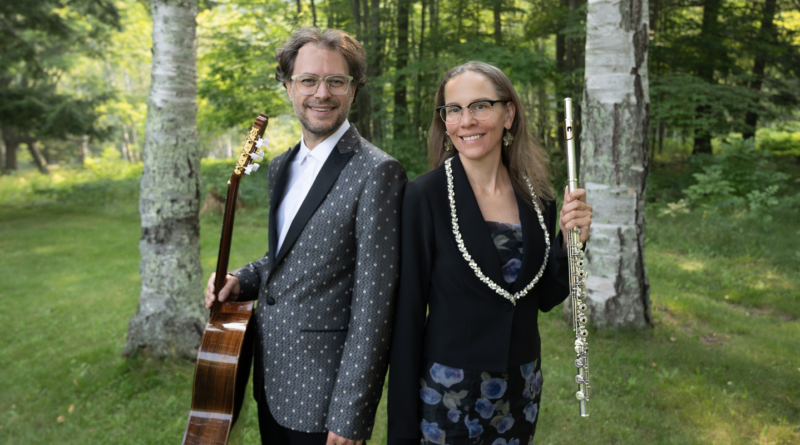
Right now, as I write this, I'm on the road. My husband Andrew Bergeron and I — together we're Folias Duo, a flute and guitar duo from Grand Rapids, Michigan — are in Ontario this week for three concerts in Toronto, Hamilton, and St. Catharines. Our new single "Lake Ontario" drops this Friday, the first taste of our upcoming ninth album Great Lakes. We booked this tour ourselves, wrote all the music ourselves, handled the artwork design. This is how we've worked for twenty years.
This is not the flute life I was told to want.
When I was studying music, the path was clear: practice, audition, get into a graduate program, audition again, land an orchestra position or a university faculty job. The flute as an instrument existed inside a very specific tradition, and success meant climbing inside it. I loved the tradition. I still do. But somewhere in my early twenties, I started feeling the edges of it, and I got curious about what was on the other side.
What I found was a lot of work — and a lot of freedom.
What "DIY" Actually Means
People hear "self-managed" and picture a musician who handles their own emails. What it actually looks like, twenty years in, is something closer to running a small creative company. Andrew and I compose all of our own repertoire — over 70 original works now. We run Folias Music, our record label. We co-direct the Folias Music School. We produce and publish our own sheet music. I design and produce most of our visual materials, from layout to marketing. We book our own tours, research our own venues, write our own press releases, build our own websites, and manage our own social media.
I also teach — at Aquinas College and Grand Rapids Community College. Teaching is not separate from the performing life; it feeds it.
None of this was part of my music education. I learned it by doing it, failing at it, and doing it again.
The Flutist as Composer
The single biggest shift in my relationship with the flute came when I started writing for it seriously. Composing changes how you hear your instrument. You stop thinking about someone else's intentions and start thinking about possibilities — what sounds live naturally in the flute's low register, what rhythms feel inevitable against a guitar's chord voicing, what the instrument wants to do when you stop asking it to do what it's always done.
My pieces pull from a wide range of influences: the rhythmic precision of Vivaldi, Argentine folk music, the harmonic world of Scriabin, the poetry of Emily Dickinson, pop music, which I celebrate as seriously as any other influence. Andrew brings his own set of obsessions — among them the Saharan blues of Tinariwen, which you can hear winding through several of the Great Lakes tracks. Together, those threads create something that doesn't fit neatly into any one genre, which is exactly where we want to be.
I write for C flute, alto flute, piccolo, bass flute — and for tambin, a handmade three-holed flute from Guinea, West Africa, with a raw, earthy sound unlike anything in the Western flute tradition.
The tambin changed me. Its physical and tuning limitations — a slightly out-of-tune A♭, a D♭ that resists control — forced me to stop thinking in equal temperament and start listening differently. Working with those "limitations" opened up new harmonic and melodic territory that has filtered back into everything I write. If you want to hear your instrument with fresh ears, pick up an instrument that doesn't behave the way you expect.
Composing in Cabins, Performing in Living Rooms
Great Lakes, our new album coming out August 14, grew directly out of the way we live and tour. Every summer, Andrew and I drive across the country to perform. We self-book into intimate venues — library series, house concerts, church gardens, gallery spaces — the kinds of rooms where the music and the audience breathe together. We camp along the way and schedule stops at rustic cabins where we write new music.
The album's central concept began when Andrew wrote the first piece in the cycle, Lake Michigan, in a cabin on the northern shore of the lake that reminded him of the cabin his father built in the woods where he grew up. From there the cycle expanded — one lake at a time — until we had a full album's worth of music rooted in the landscape we keep returning to.
There is something about that proximity to landscape and simplicity that keeps the work honest. When you're not performing in concert halls, you're accountable to the room you're actually in — and to the people sitting ten feet away from you who came to listen.
For Flutists Wondering About the Other Path
I'm not arguing that every flutist should go independent. The orchestra world and the academy hold profound musical traditions, and the musicians who thrive in those spaces do extraordinary things.
But I do think there's something worth saying to the flutist who feels the edges of the prescribed path and wonders if there's something else. There is. It requires learning skills that are completely outside your conservatory training. It requires tolerance for uncertainty and a high threshold for bureaucratic tedium. It asks you to be a musician and an entrepreneur and a producer and a collaborator, sometimes all in the same afternoon.
What it gives back is hard to overstate. You make the music you actually hear in your head. You build relationships with audiences over years, in intimate rooms, in places that don't always make it onto touring maps. You develop a relationship with your instrument that is entirely your own.
Twenty years in, 700+ concerts, nine albums — I still don't entirely know what I'm doing. But I know why I'm doing it. And this week, somewhere in Ontario, that feels like enough.
Carmen Maret is a flutist, composer, and co-founder of Folias Duo, a performer-composer ensemble she has built with guitarist Andrew Bergeron over more than twenty years of self-managed touring, recording, and composing. Known for her nuanced virtuosity and adventurous compositional voice — drawing from tango, jazz, world music, and improvisation — she has co-written over 70 original works and released nine albums on the Folias Music label. She holds degrees in flute performance and ethnomusicology from the University of Missouri–Kansas City Conservatory and Michigan State University, and teaches at Aquinas College and Grand Rapids Community College.
— Instagram/Facebook/YouTube: @foliasduo