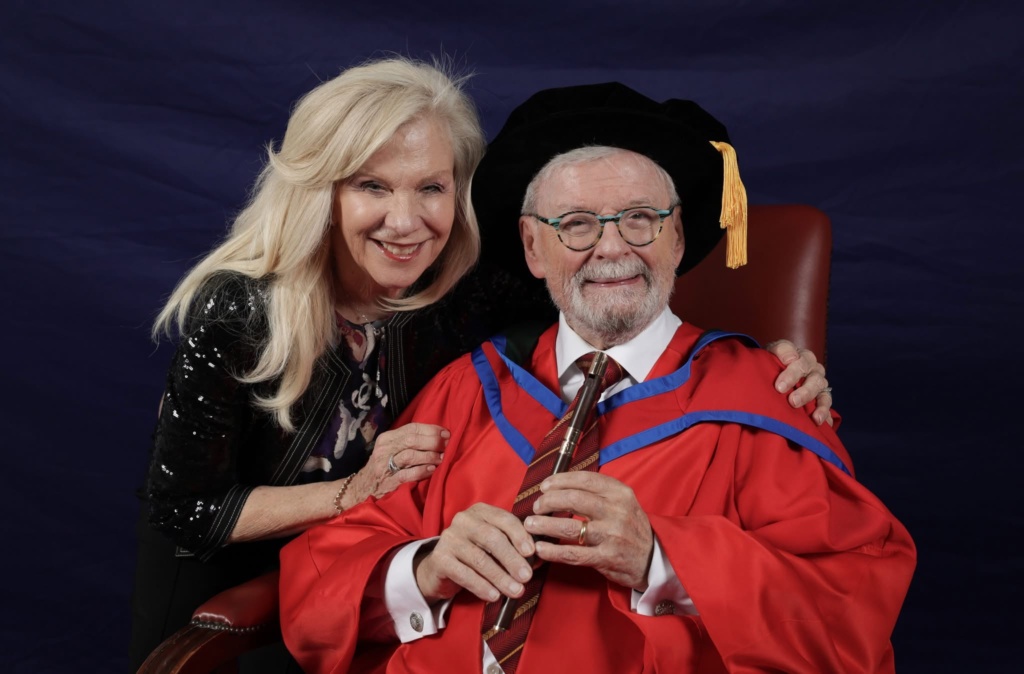
Lady Jeanne and Sir James Galway Interview
1. Beginnings & Inspirations
Lady Jeanne and Sir James, can you each share what first drew you to the flute—and what continues to inspire you after so many years on stage?
SJ: I fell in love with the flute when I was a small boy in primary school. What inspires me today is gaining ever-greater command and control of the instrument and the music.
LG: I originally wanted to play the trombone, but circumstances didn’t allow it, so I chose the flute. I remember walking into the band room with about 25 other students dropping flutes on the floor, and when I picked mine up and made a sound—well, that was it. I fell in love immediately, and I’m still in love with it. The flute continues to inspire me because it’s an ongoing exploration of colors, beauty, and expression.
How did your musical upbringings differ, and how do those early influences shape your artistry today?
SJ: My Uncle Joe taught me the flute, my grandfather played the flute, and there was always a flute and music in the house. Everyone on my street played an instrument or was in a band. The flute bands played a huge role in my upbringing from the very beginning.
LG: There were no musical instruments in my family. I was one of six children, and sports were more common, so I was the odd one out. A free school music program was truly a gift. I tried many instruments, and that early passion shaped the musician—and person—I am today.
2. Partnership in Life and Music
You’ve performed and toured together for decades. How do you balance your musical partnership with your personal one?
SJ & LG: They’re one and the same! We have a 24-hour relationship—48 when we go to Asia! We listen to music, play music, discover music, discuss music… it’s simply part of our daily lives. We’re blessed to share both a love of music and a love of life.
When preparing repertoire as a duo, do you bring distinct interpretive ideas, or does interpretation develop organically?
SJ: It develops organically through collaboration.
LG: My ears are incredibly tuned to Sir James’s playing. His approach—how he shapes a phrase, colors a scale, begins a note—his mastery is so special. By deeply listening, I’ve developed my own artistry to another level.
What do you each most admire in the other’s playing?
SJ: Lady Jeanne’s tone and musicality.
LG: Sir James’s command of the instrument and extraordinary musicality.
3. Mentorship and Pedagogy
How do your teaching styles complement one another?
LG: I get the students ready for Sir James. I’ve studied his classes for years and continue learning from him daily. I focus on strong fundamentals—foundations that many students don’t yet have. We really do have a one-two step: I prepare them, and then they play for the Master. It complements beautifully.
What are the most common challenges facing young flutists today, and how can they overcome them?
SJ: Too many distractions that have nothing to do with the flute.
LG: There’s so much information available now—wonderful, but also overwhelming. It can confuse young players when choosing whom to emulate. Online popularity doesn’t always equal musical excellence. These distractions also take away from attending live concerts. Focus is the key.
Lady Jeanne, how do you help students develop presence and confidence on stage?
LG: I share my own journey—how I grew in confidence and musical maturity. Sir James always says we are messengers of the composer; our gift is to be nurtured and shared. We also discuss the practical side: looking at the audience, standing with presence, owning the stage. It’s a holistic approach.
Sir James, what qualities define a truly great 21st-century flutist?
SJ: You can tell right away who will make it: how they present themselves, how they play, how they learn, and whether they truly have a gift. Someone who practices until the music is in their bones, studies the score deeply, and removes the blinders to fully “go for it.”
4. The Galway Flute Academy
What was your vision when founding the Galway Flute Academy, and how has it evolved?
LG: It began as a simple masterclass in Switzerland in the early ’80s, when Sir James wanted to devote more time to teaching. It grew and grew until we occupied an entire school. Our philosophy has always been inclusiveness—bringing flutists together of all levels, sharing knowledge without competitiveness. Using the foundations of Marcel Moyse and Sir James’s own experience, we aim to create camaraderie, growth, and lifelong friendships.
What makes your masterclass approach unique—how do you help students find individuality within your shared tradition of sound?
SJ: All students must play from memory. It’s essential that they feel the music from within and touch the soul of the listener.
LG: When Sir James teaches something like the Carmen Fantasie, he has students sing the phrase, feel the expression, know it in their bones. This deep internalization is at the core of our approach.
5. Artistry & Repertoire
How do you select repertoire to perform together?
SJ: There aren’t many First-Class compositions for two flutes, so the choices are limited.
LG: We’ve commissioned many pieces, but we always return to the standards because they fit well in concert programs. Cimarosa was a favorite—beautiful harmonically and pleasing to audiences. We performed Bach Trio Sonatas, the Brandenburg No. 4, and many Dopplers, plus popular and Christmas programs with special arrangements. Our duo pieces were always programmed within Sir James’s concerts, balancing repertoire for the audience.
Are there composers you feel especially connected to or wish more flutists would explore?
SJ: The complete Bach Sonatas and the Mozart Concertos.
LG: Bach Sonatas, of course. There is wonderful chamber music for two flutes by Quantz, Loillet, C.P.E. Bach, W.F. Bach, and we love our Schultze. Many Baroque works for two flutes and continuo are gems. We are careful about transcriptions—we believe some violin pieces should remain for violins. Among contemporary composers, Lowell Liebermann, William Bolcom, and Bill Whelan would be wonderful for more duo works.
How do you approach performing new works or transcriptions compared to classical standards?
SJ & LG: By learning and practicing the score with the same seriousness. For example, we practiced Phil Hammond’s Carolan Variations for two hours every day, even after performing it 100 times.
6. The Changing Musical Landscape
What changes in the classical world have you found inspiring or challenging?
The access to historical recordings—from Heifetz, Callas, Sutherland, Rostropovich, Kreisler, Moyse, and the great French flutists—is extraordinary. But it can also be confusing for young players who haven’t fully developed their ears. With so many options online, it’s important to stay open but also selective. Inspiration and challenge often walk hand in hand.
What is the role of the classical musician today in a digital, fast-paced world?
We recently worked at the University of Ulster, where digital technology and superb youth orchestras coexist. It shows young musicians that there are many paths—film, production, composition—not just orchestral careers. However, the constant presence of phones can hinder deep concentration. Ultimately, it’s still about creating something beautiful with you and your instrument.
What advice would you give emerging artists balancing artistic integrity with modern career-building?
Focus. After graduating from conservatory, the world opens up—don’t be afraid of it. Explore opportunities, funding, and different courses. Learning doesn’t end at 23. But don’t stay in school until 30 just for safety—get out there and have a good time! Today, the internet makes accessing opportunities easier than ever.
7. Legacy and Reflection
Looking back, what moments have been especially meaningful or transformative?
SJ: So many. Performing with great colleagues, hearing the Berlin Philharmonic for the first time, selling out Bach Sonata concerts as a soloist… and those moments on stage when a performance is so beautiful that the hall holds its breath.
LG: Many milestones—my first orchestra job, my first concerto after graduation, unforgettable recitals. I was reflecting recently on our first public performance together: Cimarosa with the London Mozart Players. I feared the critics might say, “Wife, go home,” but the orchestra applauded and the reviews were positive. Sir James would never have put me on stage if I couldn’t stand my ground.
How would you each like to be remembered?
SJ: As a very good flute player and a good musician who touched the souls of listeners.
LG: As someone who inspired others and carried Sir James’s legacy as far and as long as I could—and who showed that on stage every time I played.
What does the future hold—are there projects or dreams on the horizon?
LG: Always. There are ongoing projects and collaborations, including some we’ve been discussing here in Ireland. But we hope to enjoy more quiet time—walking around the lake, taking holidays. No more big tours. We’ve had a taste of the other side of life, and we’re enjoying it.
8. A Personal Touch
When you’re not performing or teaching, what brings you joy?
Everything!
If you could give your younger selves one piece of musical advice, what would it be?
SJ: Practice—get it in your bones!
LG: Enjoy the moments instead of thinking it was never good enough.