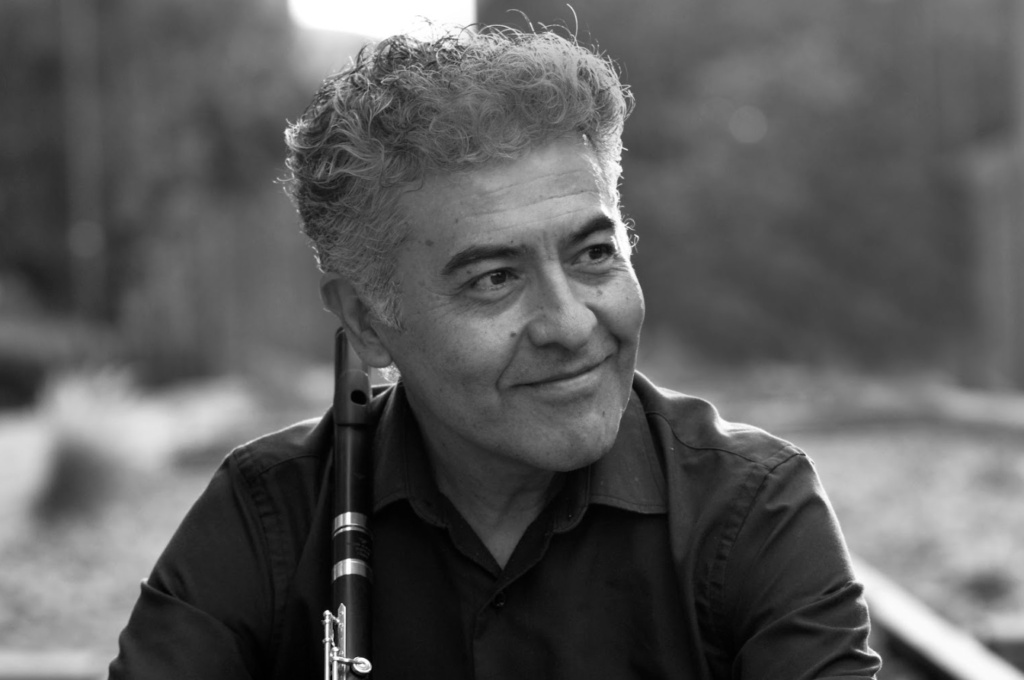
Flute Societies and Their Music: Around the World: MEXICO with Miguel Angel Villanova
Flute Societies and Their Music Around the World compiled by Natalia Jarzabek
Each country is unique, rich in valuable traditions and diversity. The idea behind this series is to present flute communities from different countries and their works for this instrument—which are usually only known in their country of origin. The goal is to disseminate valuable works of classical music for the flute and to increase awareness of flute communities in various countries so that they can learn from each other and draw inspiration for further development.
Mexico: Interview with Miguel Angel Villanueva
Miguel Angel Villanueva is one of the most active flute soloists and teachers in Mexico. He is also a Verne Q. Powell artist. His recordings include the complete works for flute by Mexican composer Eduardo Angulo, as well as flute concertos by Eugenio Toussaint, Horacio Uribe, Lucía Álvarez, and many others. Dr. Villanueva organizes the National Flute Festival and the National Flute Competition in Mexico City. He teaches at the Faculty of Music at the Universidad Nacional Autónoma de México (UNAM).
Born in Mexico City, he began his studies at the Escuela Nacional de Música (UNAM) with Roxana Lara and Héctor Jaramillo. In 1984, he entered the École Normale de Musique de Paris and the Conservatoire National de Région de Saint-Maur, where he was awarded the Diplôme Supérieur d’Exécution and Médaille d’or, respectively. His teachers include Jacques Royer, Ida Ribera, Shigenori Kudo, and Michel Moraguès. He has performed as a soloist in Germany, France, Ecuador, Brazil, Colombia, Canada, and Mexico. All his recordings are uploaded on his YouTube channel.
Could you describe the flute community in Mexico?
In the 1970s, the Orquesta Filarmónica de la Ciudad de México was created. Maestro Fernando Lozano was the conductor, and he told me that he brought almost all the strings from Russia and other East European countries, and the winds from the United States. Almost all my colleagues of my generation studied with US flutists. I remember that I wanted to broaden my horizons with a more European type of sound, particularly the French school, so I went to Paris and was able to bring that kind of sound back to Mexico. Now I think that there are no more "schools" like in the 20th Century. It's become very global.
In terms of organization, Mexican flutists have only two big Festivals, one in Mexico City and the other in Monterrey City, in northern Mexico. Other flutists have tried to organize Festivals, but they don't last because, sadly, we don't have a "sponsoring" culture. All our Festivals are organized by institutions, and they don't always have the necessary budget.
Mexican culture is, in my opinion, very diverse and rich. What is the flute art scene like? What about composers dedicating their pieces to flutists?
Academic Mexican music has many influences, such as Spanish music (15th to 18th century) and French and Italian music during the 19th century, as well as European music throughout the entire 20th century. Ancient Mexican music is almost lost since there are no recordings or a kind of music notation. Nevertheless, instruments and rhythms have survived in some ethnic groups, and from time to time, Mexican composers have tried to include them in their compositions as a reminder of our ancestors' culture.
According to research by María Diez Canedo (2014), the first flute player arrived in Mexico from Spain in 1743. But as we know, these musicians played several instruments and had to fulfill many tasks. Mexican baroque music is slowly becoming known. After the Independence from Spain (1821), the first philharmonic society was created (1826), and the flute teacher was Antonio Aduna. Starting with Aduna, we can track a flute lineage passing by Mariano Jiménez, Juan Hernández Acevedo (a student of Altès at the Paris Conservatoire), Librado Suárez, Agustín Oropeza, Rubén Islas, and Héctor Jaramillo.
I know you feel a mission to expand the Mexican flute repertoire in collaboration with composers. Why? What's the history of this endeavor?
I think it's because I realized that, when I was a student, I was a little bored playing the same flute concertos such as Mozart, Ibert, Devienne, etc. When I came back to Mexico, I did a little research and, according to Eduardo Soto Millán’s Diccionario de Compositores Mexicanos, in the whole 20th Century, we can only find about 24 works for flute and orchestra, with only 3 of them being real flute concertos; the other works are short pieces. When I heard Eduardo Angulo's music, I was really impressed by his orchestrations. On the other hand, I felt the necessity of Mexico's voice being heard through a flute concerto.
Are you performing them a lot?
Yes, fortunately! As an example, I played the second flute concerto, "Voces de la Naturaleza" by Angulo, with 20 orchestras in Mexico, Brazil, Ecuador, and Colombia.
I know that you’re also a great teacher. How do you choose repertoire for your students?
I always give them freedom to choose in the beginning, and if the suggested works are right for their level, I agree with their choice. If not, I suggest something else. I think it's very important that the students are happy with their repertoire. I only supervise that the level of the work corresponds to theirs.
Do you also suggest Mexican compositions?
In that matter, music by Mexican composers is mandatory in their recital programs. I ask them to become aware of the importance of playing the compositions of our composers. I urge them to work with composers of their generation.
How do you select composers?
I always try to commission works by experienced composers as well as young composers. If it's about chamber music, I don't tell them anything about what or how to compose. I always tell the composers: "Compose a work that makes you proud of it, a work that you will proudly say 'this is my flute Concerto or my flute and piano sonata.'" But if it's about Flute Concertos, I always tell the composers to be aware that soloists have only two rehearsals with the orchestra, so the orchestra part should not be too complicated; otherwise, conductors won't program them.
How many pieces have you already collected and performed?
I really don't know. I lost count. But I commissioned and performed about 20 flute concertos by Mexican Composers.
Are those pieces released?
Many of them are recorded, and you can find them on my YouTube Channel.
Can we find them somewhere?
Unfortunately, only some of Angulo's works are edited.
What’s your next goal with your artistic development?
I will record the "Concierto Son" for flute and orchestra by the great Mexican composer Arturo Márquez and the "Concerto for two flutes and strings" by Eduardo Angulo. I also have invitations to participate in the "Ventoux Flute Festival" in France and in the "Seminario de Flauta Traversa" in Bogotá, Colombia.
Recordings of pieces can be found on Miguel's profile at:
As an example of a beautiful composition we recommend listening to Double Concerto for Flute and Harp by Eduardo Angulo