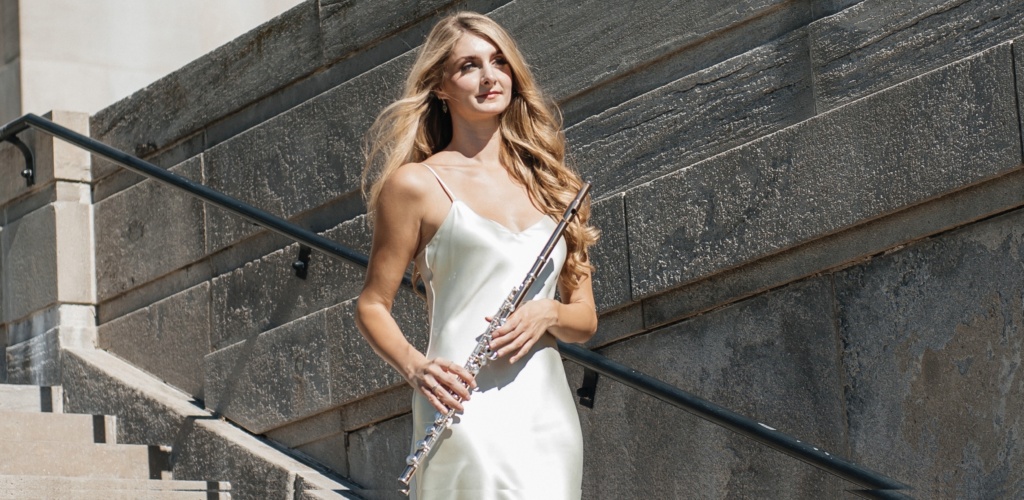
Canadian Flutist Studying in Paris: Rachel Szabo Artist Interview
Can you give us 5 career highlights?
It’s hard to narrow it down! If it’s okay, I’ll give six:
- Performing Stravinsky’s Rite of Spring as Principal Flute with the Copenhagen Philharmonic (2022) challenged me both technically and musically and helped me grow as a principal player.
- Performing Stravinsky’s Firebird with the National Arts Centre Orchestra of Canada (2024) on just 24 hours’ notice was terrifying but thrilling. I grew up listening to that orchestra, so joining them on stage meant a great deal.
- Joining the Canadian Opera Company for La Reine Garçon (2025), a contemporary opera by Julien Bilodeau, was my first time performing an entire opera with the composer present — a uniquely inspiring experience.
- Performing Brahms’ Fourth Symphony on tour as Principal Flute with the National Youth Orchestra of Canada (2022), where I received the Payne-Lyon Prize and later the Award of Excellence, was one of my most formative musical experiences.
- Spending the 2023–24 season as Acting Second Flute / Piccolo with the Victoria Symphony taught me an enormous amount — playing full-time and learning new repertoire each week all while sitting next to one of my closest friends made it a really fun and meaningful year.
- Winning the Second Flute / Piccolo position with my hometown Kingston Symphony last September (2025) felt incredibly full circle, since the position had previously been held by my very first flute teacher, who I started lessons with at age four.
What do you like best about performing?
The best thing about performing is knowing I’m part of something greater than myself. On stage, I’m not just playing notes — I’m contributing to a shared experience that can move people, awaken emotions, and weave a connection between everyone in the room. Being able to touch people’s hearts in that way is the most fulfilling experience I know.
What does your schedule look like for the next 6 months?
My schedule involves a lot of travel at the moment, as I’m currently based between Paris and Toronto. I spent the past few months in France and am now back in Canada from January until March, performing two operas — Rigoletto and The Barber of Seville — with the Canadian Opera Company. Between rehearsals and performances, I’ll be at the Four Seasons Centre for Performing Arts almost every day with a total of 14 shows. I’m continually inspired by this group of musicians and feel incredibly grateful to be joining them again.
In March I’m back in Paris, and I’ll return home in late April to perform Mahler’s Fifth Symphony with the Kingston Symphony. After deferring the role last season to pursue studies in Paris, I’m thrilled to be able to join them for a concert this season.
Looking ahead, I’m honoured to perform Mahler’s Second Symphony in Lyon this June alongside my current professor, Julien Beaudiment — an experience I once would have only dreamed of.
Who were your music mentors? What did you learn from them?
I’ve been fortunate to study with teachers who combine exceptional artistry with a deeply human approach, sharing similar philosophies rooted in openness, humility, and integrity.
During my master’s degree in Copenhagen, I studied with Ulla Millmann. She taught me that vulnerability is a strength, and that being a musician means leading with honesty. Her sincerity left a lasting impression on me.
My current teacher, Julien Beaudiment, inspires me through both his artistry and his humanity. There’s a rare honesty and depth in his playing that goes straight to the heart, and that same integrity and openness are reflected in the way he interacts with others. He makes everyone around him feel respected and valued, and his guidance has been transformative for me as a musician and collaborator. It’s truly an honour to be his student.
How do you like living in France as an American? Pros & cons?
I’m actually Canadian! I would encourage any North American to study abroad if they have the opportunity — it’s a transformative experience that pushes you beyond your comfort zone and helps you grow in ways you never imagined.
There’s a common misconception that French culture can be unwelcoming to North Americans, but I’ve personally felt very welcomed, especially within the music community.
I was fortunate to complete my master’s degree in 2023 at the Royal Danish Academy of Music essentially for free thanks to my EU citizenship, and I’m very happy to be back in Europe now. Adjusting to a new culture and way of life can be challenging at first, but I see it as an opportunity for growth. From navigating daily life in a second language to studying in a new musical environment, every experience has strengthened my resilience, adaptability, and independence. For me, there aren’t really any “cons” — just valuable lessons that shape you as both a musician and a person.
Can you give us 5 quirky, secret, fun hobbies or passions?
I’m part of a poetry club and love having a creative outlet beyond music. Jericho Brown is my favourite!
Running is a big part of my life — I’ve run seven half marathons in five different countries and completed a full marathon in 2019. I love testing my limits both mentally and physically.
I love diving into a good novel. Elena Ferrante and Donna Tartt are two authors I think everyone should read — their work is brilliant.
I enjoy playing chess, especially with my sister. It’s also a good way to kill time on long flights.
I have a black belt in karate, something most people don’t know about me. The sport has taught me a lot about discipline and mental toughness.
What do you like best about teaching?
Being young is already challenging, and pursuing a less traditional career path adds another layer. The most rewarding part of teaching for me is helping young musicians feel seen. I’m very open with my students, and I try to eliminate hierarchies as much as possible. It’s incredibly fulfilling to watch students begin to flourish when they feel supported, and sometimes that growth isn’t even about music.
What 3 things would you offer as advice for a young flutist?
Stop obsessing over perceived prestige, awards, accolades, and conservatory names.
Some of my greatest “failures” opened doors to my biggest opportunities. Rejection is just redirection.
Trust your own unique journey — there is no wrong path.