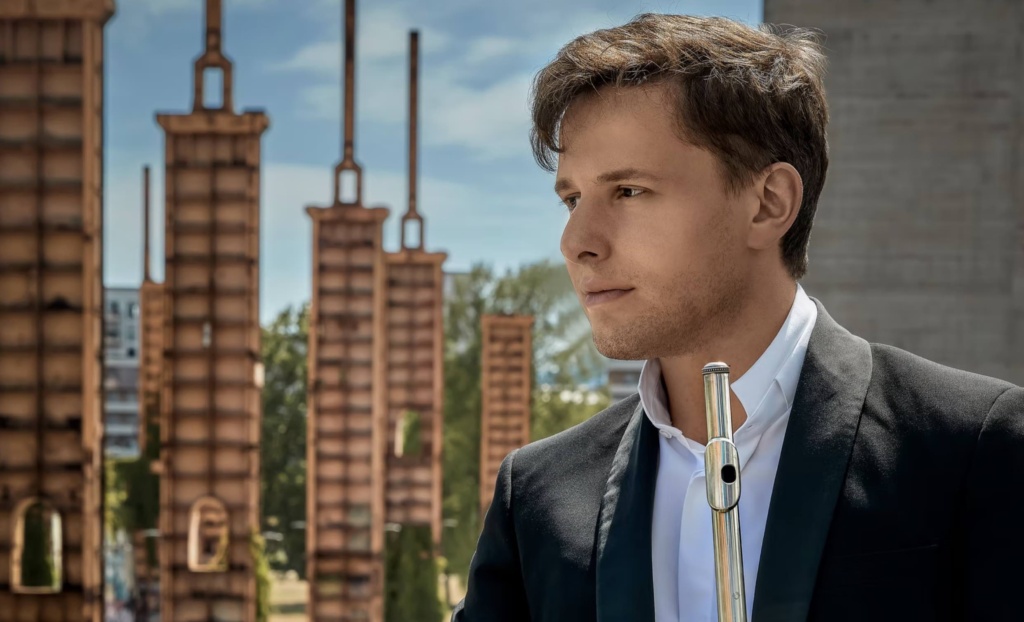
Carl Nielsen Competition Winner 2022, Alberto Navarra Artist Interview
Alberto Navarra is rapidly emerging as one of the most exciting and accomplished flautists of his generation, acclaimed for his exceptional artistry, technical prowess, and captivating stage presence. With numerous prestigious awards and performances at some of Europe's most renowned venues, his recognition as one of Classic FM’s Rising Stars for 2024 further underscores his growing prominence in the classical music scene. A defining moment in Alberto’s career came in 2022, when he claimed 1st Prize at the prestigious Carl Nielsen International Flute Competition in Odense, Denmark, cementing his reputation as a world-class talent. This triumph followed earlier accolades, including successes at the Severino Gazzelloni International Flute Competition (2021) and the Dorel Baicu International Competition (2020), highlighting his consistent excellence and commitment to his craft. In the same year, Alberto’s artistry earned him a coveted position in the Karajan Academy of the Berliner Philharmoniker, where he studied where he studied with the support of De Sono, and performed alongside legendary flautist Emmanuel Pahud and other distinguished members of the orchestra.
As part of this prestigious institution, Alberto performed on renowned stages such as the Salzburg Festival, Lucerne Festival, BBC Proms, Baden-Baden Festspiele, and more, under the baton of celebrated conductors including Kirill Petrenko, Ivan Fischer, and Christian Thielemann. Alberto's solo career flourished with engagements with prestigious orchestras, including the Aarhus Symfoniorkester, Odense Symfoniorkester, Tampere Filharmonia, and the Royal Stockholm Philharmonic Orchestra. As principal flutist, he collaborated with distinguished ensembles such as the Orchestra del Teatro La Fenice in Venice, La Filarmonica di Milano, Orquestra Simfònica de Barcelona, and KonzerthausBerlin.
A passionate chamber musician, Alberto frequently performs at celebrated European festivals, including Davos and Aix-en-Provence, showcasing his unique voice and deep interpretative insight across a diverse repertoire. His artistry has also been recognized with his appointment as a Classeek Ambassador by Emmanuel Pahud, leading to solo and chamber recitals in Switzerland. Hailing from Mondovì, Italy, Alberto began his musical education at the Conservatorio di Musica Ghedini in Cuneo, later studying under masters such as Andrea Oliva and Jacques Zoon at the Escuela Superior de Música Reina Sofía in Madrid. In 2023, Alberto was appointed Solo Flutist (2nd/3rd Flute) with the TonhalleOrchester Zürich, solidifying his place among the elite in the classical music world.
Following his victory at the Nielsen Competition, he recorded his debut solo album with the Odense Symfoniorkester for the esteemed British label Orchid Classics, further demonstrating his artistic vision and brilliance. Named as one of Classic FM’s Rising Stars for 2024, Alberto Navarra is undoubtedly a name to watch in the classical music world. With his extraordinary talent, boundless passion, and relentless pursuit of excellence, he is not just a flautist—he is a true storyteller, innovator, and an influential force in today’s classical music landscape.
1. Can you take us back to your earliest encounters with the flute? What first drew you to the instrument, and when did you realize it would become a central part of your life?
I actually started the flute quite by chance. In middle school there was an opportunity to study a musical instrument for free, and my first choice was the guitar. When there were no places left, I was assigned to the flute class instead. From the very beginning, however, I felt an immediate connection with the instrument. I found that it came naturally to me, and that sense of ease quickly turned into passion. It was then that I realized the flute could become my path, and I decided to dedicate myself fully to studying it.
2. Who were the most formative teachers or mentors in your musical development, and what lessons—musical or otherwise—have stayed with you?
I have been fortunate to learn from several teachers who have shaped my musical development in different and essential ways. My very first teacher in middle school, Paola Parretta, immediately believed in my potential and encouraged me to believe in myself. At the conservatory in Italy, Maurizio Valentini and Andrea Oliva provided me with a solid technical foundation and gave me the tools necessary to pursue this profession. Later, at the Escuela Superior de Música Reina Sofía in Madrid, Jacques Zoon was a tremendous source of inspiration, especially in terms of expressive depth and emotional communication. Finally, at the Karajan Academy in Berlin, Emmanuel Pahud and Sébastian Jacot were important role models for me, both as soloists and as orchestral musicians, setting an example of artistic excellence and professional discipline.
3. What motivated you to apply for the Carl Nielsen Competition, and what did the experience mean to you personally and artistically?
The Carl Nielsen Competition had long been a point of reference for me, especially since Sébastian Jacot won it in 2014. When the time came to submit my application, I certainly did not imagine that I could win; simply being invited to participate already felt like an extraordinary achievement. I still remember receiving the invitation—I was overjoyed and completely speechless. I prepared intensively for the competition, dedicating a great deal of time and energy to my practice. At the same time, I made a conscious decision not to play the repertoire for any of my teachers beforehand, in order to develop a more personal approach and a deeper individual connection to the works I was performing. The experience was both artistically and personally transformative.
4. Can you share a memorable moment from the competition—on or off the stage—that still resonates with you?
There were many intense and emotional moments during the competition, but one stands out in particular—the day before the semifinal. I vividly remember how nervous I was before the rehearsal of Jolivet’s concerto with the string orchestra. I had never performed it before, not even with piano, and the piece had to be played entirely from memory. Just before the rehearsal, I seriously considered withdrawing from the competition, convinced I wasn’t prepared enough. In the end, I decided to go ahead with the rehearsal and see how it would feel, planning to make a decision afterward. Once I started playing, everything felt surprisingly natural, and the rehearsal went well. That moment gave me the confidence to stay and continue the competition.
5. Winning such a prestigious competition can be life-changing. How did the announcement affect you in that moment, and how has it shaped your path since?
The Nielsen Competition became a true launching pad for my career. When my name was announced, I honestly couldn’t believe it at first. From that moment on, I received many concert invitations and had the opportunity to take part in high-level musical experiences. It felt like a dream coming true—especially in terms of performing as a soloist with major orchestras.
6. What advice would you offer to young flutists preparing for major competitions today?
My advice would be to take every opportunity available. Many young musicians hesitate to apply for competitions because they don’t feel ready or believe they’re not good enough yet. I think it’s important to take the leap and try. I myself have lost several competitions even after winning the Nielsen Competition. A competition does not define your value as a musician—it is simply a platform for visibility and, potentially, for opening doors to new career opportunities.
7. How do you stay grounded and creatively curious as your career continues to gain international visibility?
Setting new goals is always important for me. The Nielsen Competition gave me visibility and concert opportunities that allowed me to explore the repertoire and discover what suited me best. Resting on my laurels isn’t really my style—right after, I entered other competitions that didn’t go as well. Still, I’m glad I challenged myself and put myself out there without fear of others’ judgment.
8. What values do you hope to pass on to the next generation of flutists?
I hope to share my approach to music with younger flutists. I want them to understand that moving themselves and their audience emotionally should take priority over a wrong note or a “perfect” execution—of course, always with respect for the music and the composers.
9. How do you see the role of the classical flutist evolving in today’s musical landscape?
I believe the modern flutist must be truly versatile, equally comfortable as a soloist, an orchestral player, or in chamber music. Beyond technical skill, they need a deep musical understanding and a broad knowledge of the repertoire, so they can bring insight and authenticity to every performance.
10. Finally, what dreams or goals are guiding you right now—both musically and beyond the stage?
Right now, I’ve just begun a new chapter as principal flute of the Luxembourg Philharmonic Orchestra. I’m very happy to have found such a stimulating and welcoming environment. I feel very satisfied with my life at the moment, as I’m finally able to maintain a healthy balance between a busy musical life and time off stage to pursue my interests and nurture relationships.