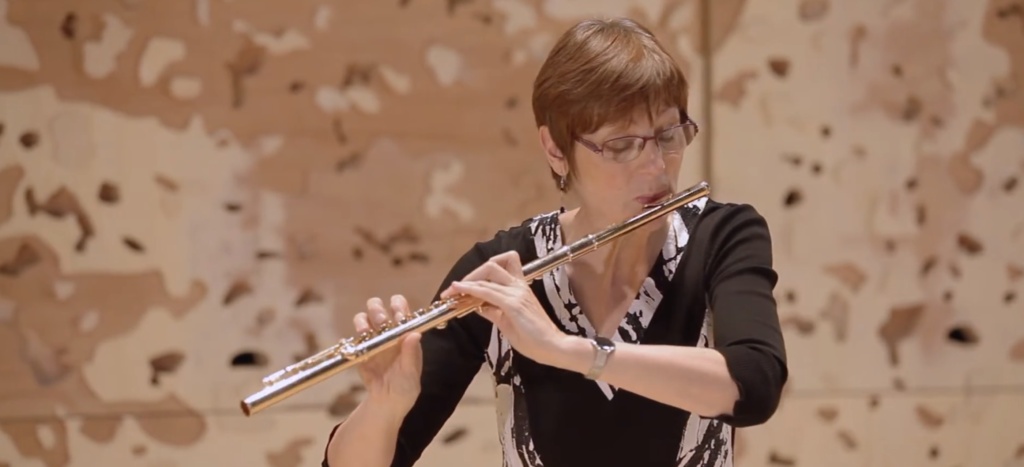
Chair of the Jury of the Nielsen International Flute Competition, Sophie Cherrier, Artist Interview
Sophie Cherrier received her musical training at the Conservatoire of Nancy before continuing her studies at the Conservatoire National Supérieur de Musique de Paris, where she graduated with highest honors in both flute and chamber music. In 1979, she joined the Ensemble intercontemporain, quickly establishing herself as one of the foremost interpreters of contemporary flute repertoire. A dedicated champion of new music, Cherrier has participated in the premieres of numerous landmark works, including Mémoriale by Pierre Boulez, Esprit rude/Esprit doux by Elliott Carter, and Chu Ky V by Tôn-Thất Tiết. Her close artistic collaborations with many of today’s leading composers have placed her at the center of the modern music landscape for several decades.
Her extensive discography reflects this commitment, with notable recordings of Pierre Boulez’s …explosante fixe… (Deutsche Grammophon), Mémoriale, and the Sonatine pour flûte et piano (Erato). She has also recorded Luciano Berio’s Sequenza I (Deutsche Grammophon), Ivan Fedele’s Imaginary Sky-lines for flute and harp (Adès), Philippe Manoury’s Jupiter and La Partition du ciel et de l’Enfer (collection Compositeurs d’aujourd’hui), Pierre Jodlowski’s Dialog/no Dialog (Sirènes), and more recently Matthias Pintscher’s Beyond (a system of passing) (Alpha). Cherrier has appeared as a soloist with many of the world’s leading ensembles and orchestras, including the Hallé Orchestra of Manchester, the Cleveland Orchestra, the Los Angeles Philharmonic, the London Sinfonietta, and the Berlin Philharmonic. Equally devoted to pedagogy, Sophie Cherrier has taught at the Conservatoire de Paris since 1998 and regularly gives masterclasses in France and internationally. In recognition of her significant contributions to musical life, she was named Chevalière des Arts et des Lettres in 2011.
Can you give us five career highlights?
It’s difficult to choose.
Winning the competition to become a soloist with the Ensemble Intercontemporain;
Performing Le Marteau sans maître by Pierre Boulez at the Sydney Opera House;
Appearing as a soloist at Carnegie Hall in New York;
My appointment as Professor at the Conservatoire National Supérieur de Musique et de Danse de Paris (CNSMDP).
What do you like best about teaching?
Teaching has always been my passion. I enjoy working with small groups because it allows for greater interaction.
I try to guide students and give them tools without imposing too much, even though my own aesthetic and taste are inevitably present.
As a teacher, one cannot constantly reinvent oneself, but the approach must be different depending on each student’s personality, strengths, and vulnerabilities.
This relationship with each student gives me a great deal. I hope I give as much back to them.
What do you like best about performing?
Above all, I love sharing musical moments with colleagues, conductors, and the audience.
I also enjoy the challenge of working on new and difficult pieces, and trying to understand entirely new musical languages.
What does your schedule look like for the next six months?
Teaching at the conservatoire;
A masterclass in Rotterdam;
Concerts with my ensemble in France, as well as in London and Tokyo;
And, of course, serving on the jury of the Nielsen Competition.
What are your goals personally and professionally?
Personally: to stay healthy for as long as possible so I can take care of my family.
Professionally: simply to remain healthy enough to continue enjoying musical moments and sharing them with young musicians.
What inspires you most in life?
Sharing.
Who were your musical mentors, and what did you learn from them?
My teachers Jacques Mule and Alain Marion taught me everything about the flute.
Later, Pierre Boulez became my mentor. I was 20 years old when I became a soloist with his ensemble, and I learned rigor, respect for the score, sincerity, and integrity.
It wasn’t always easy—I was young, and he wanted things to succeed—but what a privilege it was to play under his direction and to be shaped by him and my colleagues.
Can you give us five quirky, secret, or fun hobbies or passions?
Humor, nature, the mountains, and a good meal.
What three pieces of advice would you offer a young flutist?
– Work hard to be at your best and to enjoy yourself;
– Try to trust yourself;
– Be as natural and sincere as possible with your instrument, which is the language of words.