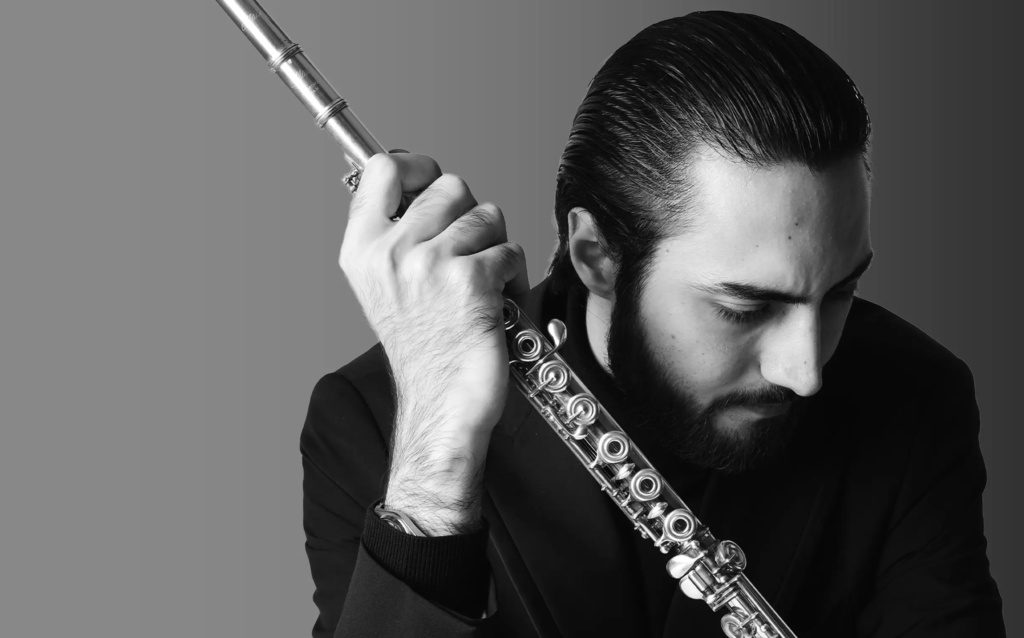
Fluting From Baku to Paris, Agharahim Gouliyev Artist Interview
Agharahim Gouliyev is a renowned Azerbaijani Flautist and Producer. Throughout his career, Gouliyev has become celebrated for his interpretations of both classical and contemporary works. He has excelled as a solo performer and in collaborations with orchestras, chamber ensembles, and other musicians, establishing himself as a talented artist, and producer.
Can you give us five career highlights?
I will start from early childhood and move chronologically to the present day.
1. At the age of 11, I performed with the Azerbaijan State Philharmonic Orchestra, playing a three-movement concerto. I honestly no longer recall which one exactly—it was either Demersseman’s 6e Solo de Concert or Mercadante’s Concerto in E minor.
2. My introduction to and studies with Salvatore Lombardi at the Yuri Bashmet Russian Academy.
3. Participation in masterclasses with James Galway, Linda Chesis, and Emmanuel Pahud.
4. The creation of a chamber ensemble together with my friend and colleague Eldaniz Alakbarzade.
5. Most recently, the founding of a production initiative and the release of my debut album.
Of course, this is not the full picture. I could spend hours writing about competitions and concert venues such as the UNESCO Headquarters in Paris, Salle Cortot, the St. George Hall of the Moscow Kremlin, or the Grand Hall of the Moscow State Conservatory. However, I consider this a natural part of an artist positioning themselves as a soloist. What truly shaped me were the influences of the pedagogues with whom I studied and took masterclasses—these experiences were fundamental to my artistic development.
How about three pivotal moments that were essential to creating the artist you’ve become?
The first moment—one that was completely beyond my control and purely a matter of chance—was being born into a family of musicians. My mother and grandmother were both pianists, and music was constantly present in our home. I continuously heard my motherpracticing, as she accompanied many musicians and taught extensively. My grandmother began teaching me piano at the age of five and developed me far beyond what would normally be expected at that age. The second pivotal moment was my admission to the École Normale de Musique de Paris and move to Paris. The city deeply influenced me with its cultural depth, much like Saint Petersburg did during my childhood. Beyond that, the pedagogues at the École Normale had an enormous impact on me—their contribution to my artistic formation is truly invaluable. The third moment may sound quite heavy: the loss of close family members. When I was 22, my father passed away, and at 23, my grandmother followed. Losing two people on whom I relied so deeply naturally affected me, especially at such a young age. While this experience had its painful aspects, it was not only negative. I now see how rapidly I matured and how
profoundly my perception of life changed, which in turn significantly influenced my perception of music as a whole.
What do you like best about performing?
I feel alive on stage. I am able to speak with the audience about something deeply intimate without saying a single word in any language—yet everything is understood. I usually choose my repertoire based on my inner state. For me, the stage is not a pedestal for self-assertion or fame, but rather a moment of personal confession. I feel something and want to transmit that feeling, and what is most rewarding is that there are always people in the audience who truly sense it—even if they seem to be fewer and fewer. I especially love the silence between movements within a work. It creates the sensation that time has stopped and, at the same time, draws the listener toward the performer and the performer toward the listener for a single second—before both return to the space of sensations. In my view, this is far more important than a beautiful costume or a golden
instrument.
You are originally from Azerbaijan. Tell us about your journey from Baku to Paris.
I cannot say anything that would truly surprise or shock you. From early childhood, as a musician, I wanted to be a soloist. Beyond the teachers who surrounded me, the person who shaped me most as an artist was my grandmother—herself a pedagogue, soloist, and accompanist. She set a demanding workload for me and prepared me mentally for the difficulties of a professional career. After meeting Salvatore Lombardi in Italy, and following his advice, I began seriously considering a move to Italy to pursue higher education and prepared for it over a long period of time. However, life had other plans. At the age of 16, I was unable to obtain an Italian visa due to being a minor, despite having the consent of both parents and an official invitation from a professor. As a result, I had to remain in Baku and enroll in the first year of my bachelor’s degree at the Baku Music Academy.
Six months later, by decision of the Ministry of Culture of Azerbaijan, I was invited to participate in a concert at the UNESCO Headquarters in Paris in 2017. That was, in fact, my first time in France. At that moment, a friend of mine—already studying piano at the École Normale de Musique de Paris—suggested that I apply. I hesitated for a long time, assuming I would not be granted a student visa since I was still only 17. My original plan had been to complete my bachelor’s degree in Baku and pursue a master’s degree abroad. Nevertheless, I decided to apply. By coincidence, classes at the École Normale begin on October 1, and my birthday is on September 25. Thanks to this timing, I legally fulfilled all the requirements to be considered for a visa. Another six months passed, and I arrived in Paris, enrolled at the École Normale—without speaking French at the time. When the director asked which pedagogue I wished to study with, a discussion began that, after my question “Do you have a teacher who speaks good English?”, led to the director assigning me to the class of Patricia Nagle. For the next six years, she devoted herself selflessly to shaping me into the artist I am today. They were the happiest six years of my life—and most likely the most demanding six years of Patricia’s professional life.
CD releases?
Very recently, I released an album featuring Carl Reinecke: Sonata “Undine”, recorded together with the same friend I mentioned earlier—Vurghun Vakilov. We studied together at the École Normale de Musique Alfred Cortot and, at that time, even shared an apartment. As a result, we were constantly playing together. In fact, our joint performances began back in Baku during early childhood, when we could not possibly have imagined that one day we would study together in Paris and later, as graduates, record an album. Last November, Vurghun came to Paris, and we decided to give a recital. I had sent him the score of Reinecke’s sonata in advance, and the work deeply moved him. It is a great privilege to develop a project not simply with a colleague, but with a childhood friend. At some point, the idea emerged to record and release the entire sonata as a digital release. Naturally, toward the end of the year, both of us were quite exhausted, and nothing came easily. However,conveying the essence and meaning of the work was our primary goal, and that ultimately became our main source of motivation.
What does your schedule look like for the next six months?
Practicing, practicing, practicing—and then practicing again. Recently, I have been teaching a great deal and giving recitals here in Paris. In parallel, as the director of a chamber ensemble, I have to balance many responsibilities. Setting bureaucracy aside, the next six months will be filled with extensive teaching, a substantial number of concerts in February, March, and April, as well as potential international engagements, although not all details have been confirmed yet.
What are your goals—personally and professionally?
Lately, I have been teaching extensively, and pedagogy has long attracted me quite naturally. I believe that my overarching goal as an artist is to reach the deepest possible level of perception and understanding, and to develop to a point where I can then prepare others and pass on skills and professionalism to the next generation. I want to offer audiences genuine emotions on stage and to share my accumulated experience with younger musicians, making their path easier, so that art, in a sense, does not completely lose its meaning. As for my personal dreams as a soloist—although this may sound immodest—they include performing at venues such as Lincoln Center, the Verbier Festival, and many other stages
where I hope to appear one day.
What inspires you the most in life?
Faith. I have nothing more to add.
What has been your greatest professional challenge?
The most difficult professional period for me was between the ages of 15 and 17, when I essentially hit a technical ceiling. I was struggling with fundamental issues—incorrect posture, forced playing, an unstable and impure sound—and I urgently needed a mentor. I needed a pedagogue who could observe the situation from the outside and guide me in the right direction. After meeting Salvatore Lombardi in Italy in August 2015, I was fortunate to receive not only several lessons from him but also a clear methodological foundation, including Taffanel & Gaubert, Bernold – La Sonorité, and related studies. Nevertheless, after returning to Baku, I still required a teacher rooted in the European school who could consistently supervise my development and lead me forward. Until the end of 2016, I struggled intensely, essentially trying to teach myself correct embouchure position and diaphragmatic support, and naturally making many mistakes along the way. At the same time, I was expected to perform in orchestras, give concerts, and pass examinations. Fortunately, I did not break before Patricia Nagle entered my life. Once I began working with her, everything gradually fell into place. That year and a half—during which my repertoire and workload were growing while I was left alone with myself and methodology, combined with the difficulties of adolescence—was extremely challenging.
What has been your greatest personal challenge?
Earlier in my life, the main difficulty was balancing studies, work, and career simultaneously. In practical terms, the challenge was physical endurance under an intense workload. Today, the challenges are different: maintaining motivation during difficult periods, working consistently on myself and my habits, developing self-confidence, and learning how to set clear priorities.
Who were your musical mentors, and what did you learn from them?
My primary mentor over a long period of time—and even today—is Salvatore Lombardi. He was not merely a teacher for me, but a role model, and I am deeply grateful to God that I encountered him at such a young age. His lessons at the academy, when I was still a child, went far beyond dry methodology. They combined emotional and strategic thinking, training in endurance, and a correct attitude toward the profession. This had a profound impact on me and is precisely what enabled me not to break under pressure and to overcome many of the challenges I faced throughout my childhood and adolescence. Later came Patricia Nagle, whom I joined as a rather stubborn and, in some sense, lost student. For a long period—certainly more than three years—she worked with me not only as a methodical teacher, but simultaneously as a psychologist, a friend, and a parental figure. When I lost my father, I was in my final year at the École Normale de Musique Alfred Cortot, and her human support played an enormous role. Without it, I believe I might have fallen into depression.
I consider myself incredibly fortunate with my teachers in life. Observing some of my friends who studied abroad, I can say with confidence that my situation was exceptional. To this day, I remain in close contact with my pedagogues, and God willing, I always will. Their support, advice, and motivation have shaped me into the person and artist I am today. Many can be good teachers—but being a truly good human being is something far rarer.
Can you give us five quirky, secret, fun hobbies or passions? Don’t think too much about it.
I probably won’t surprise you here, but one of my more unusual passions is horology. From early childhood, I was fascinated by the mystery of mechanical watch movements. Over time, this fascination developed into a serious hobby, and today I own a fairly large collection of wristwatches that I have completely assembled myself—from the movement to the bracelet and clasp. Unfortunately, this hobby requires a great deal of time, and due to my current workload and rehearsal schedule, I have had to put it aside recently.
What three things would you offer as advice for a young flutist?
1. Sound and musicality do not depend on the brand or the metal of the instrument. You are the sound.
2. Teachers are not there to do the work for you. If you do not truly want it, even James Galway will not be able to help you.
3. To overcome stage stress, you need to perform more often and practice a minimum of two hours every single day. There is no other remedy.
4. When it feels like there are millions just like you and you are no different, stop comparing yourself to others. Focus on the work in front of you and study the repertoire on your own terms. Work as you feel it—while continuously developing yourself mentally and spiritually, not by convincing yourself that technical limitations are somehow your “special feature.” Work on yourself, identify your weaknesses, and begin correcting them step by step. With time and patience, the results will come— often beyond what you expect.
5. A “star” career in classical music is not waking up, scrolling through Instagram for hours, having a long breakfast, and then playing scales for half an hour. A real career is built on self-sacrifice and constant work—both physical, to preserve your health under heavy demands, and professional. If you want to achieve something significant, do not wait for anyone. Act now, and do the maximum you can at this very moment. You will only be seen, heard, and noticed if you do not stop halfway. Believe in yourself and never allow anyone to break your inner core of confidence.
Strength lies in action !