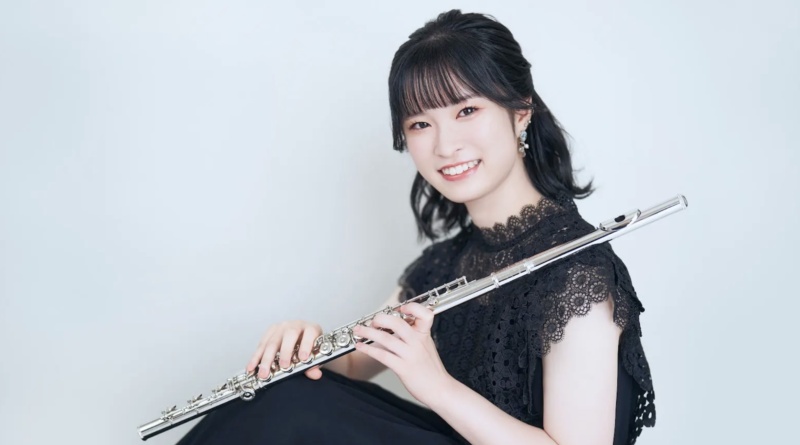
Vietnamese International Flute Festival 1st Prize Winner from Japan Ayane Ninomiya
Ayane Ninomiya is a graduate of the Tokyo University of the Arts and currently a second-year student in the master's program at the Tokyo University of the Arts Graduate School.
Congratulations on winning First Prize at the Vietnamese International Flute Festival! How does it feel? What did you learn from the competition?
I am truly delighted and honored to have received the prestigious First Prize and the Audience Award at the competition held as part of this inaugural festival.
As is the case with any competition, I find it challenging to prepare myself so that I can perform at my very best under any circumstances.
This time as well, my state of mind changed significantly between the moment I stepped onto the stage and the moment I began playing. In the preliminary round, in particular, I wasn’t able to play as well as I had hoped, likely due to nerves. The tension and the unique atmosphere of the moment are experiences you can only have at a competition, so I feel this was another invaluable experience for me.
How is it that you decided to attend VIFF?
I wanted to take lessons from flutists active overseas, starting with Mr. Sebastian Jacot!
I had never attended a workshop abroad before and had a lot of anxiety about the language barrier, but one of the reasons I felt a little more at ease was that the accompanist for the competition was Ms. Naoko Ishibashi—whom I had seen perform in Japan—so I knew I could communicate in Japanese, and Mr. Abe, a guest artist whom I had met once in Japan, was also there.
Can you give us a short description of your time at VIFF?
On the first day, there was a free, lavish dinner and show, and throughout the festival, there were concerts and lessons every day. Students were free to sit in on the lessons, and they also had the opportunity to perform in the competition—it was a very fulfilling experience.
Can you describe your role(s) and activities at VIFF?
I took a total of four lessons: two with Mr. Jacot, and one each with Ms. Erin Bouriakov and Ms. Park. (Each lesson was 40 minutes.)
I also took a flute orchestra lesson with Ms. Guzman and participated in an ensemble concert with the flute orchestra.
Every morning, there were also basic lessons, and the environment allowed me to attend them freely.
I also competed in a competition and was invited to perform in a gala concert to commemorate winning first place.
What did you love best about VIFF?
The fact that you can take lessons from multiple teachers, not just one. And the fact that you can sit in on lessons. It was also great to be able to mingle with the teachers over dinner.
What three things did you learn after attending VIFF?
First, language skills! I can speak very little English, and I realized just how much of a problem that was. Everyone around me was kind enough to speak Japanese, speak simple English slowly, or use translation apps so we could communicate, but I decided to use this as an opportunity to study properly and become fluent.
Next were the lessons with the teachers. They were truly wonderful lessons. They taught me so much—from how to approach and interpret music, to breath control, how to produce a lustrous tone, and even the basics of tonguing—making it an unforgettable experience.
Finally, the teachers’ performances! I believe there’s no better way to learn than listening to the teachers perform in concert. Building on what I’d learned in lessons, I came to understand what each teacher values most and realized, “So that’s what they meant in class!”
-=-=-=-=-=-=-
How about 3 pivotal moments that were essential to creating the artist that you've become?
The first was when I was 16, a sophomore in high school. It was when I advanced to the national finals of the All-Japan Student Music Competition (the largest student competition in Japan for flute). At the time, I was a member of a very active wind ensemble club, and I was mentally exhausted—I even thought about quitting the flute altogether. Advancing to the national finals at that moment gave me the motivation to look forward and try a little harder.
The second was when I won second place at the Japan Wind and Percussion Instrument Competition during my third year at Tokyo University of the Arts. I had been accepted into the university of my dreams, but I was starting to feel anxious about my future. Winning that award gave me hope—it was the moment I realized I might actually be able to make it in this field.
The third was when I performed as a guest musician with the NHK Symphony Orchestra during my first year in graduate school at the Tokyo University of the Arts. It was my first time playing with a professional orchestra, and I discovered the joy of performing alongside such wonderful musicians. That’s when my dream of making a career in this field and becoming an orchestral musician became crystal clear, and I’m currently working hard to make that dream a reality.
Who were your music mentors? and what did you learn from them?
Studied the flute under Ms. Naomi Oda, Ms. Kanako Akaki, Ms. Yoshie Ueno, Ms. Ayako Takagi, and Mr. Hiroaki Kanda.
They taught me a wide range of things, including the joy of playing the flute, how to plan and work toward completing a piece, the necessary playing techniques and practice methods, the joy of performing music, and basic body mechanics.
What do you like best about performing?
It’s about infusing my own emotions into the music. Music is where I channel the emotions I’ve gained from my own experiences. I get completely immersed in the music when I play, and it makes me even happier when I feel that emotion reaching the listeners.
What does your schedule look like for the next 6 months?
My schedule includes competitions in Japan, concerts at graduate schools, my own solo recitals, work as a session musician with orchestras, and teaching students.
How will you prepare for the new school year?
I plan to continue my graduate studies next year, so I’d like to start preparing for my master’s thesis soon. I also have an orchestra audition coming up, so I want to do my best with both my studies and the audition.
What do you love most about attending your music school in Tokyo?
I really like the environment here, where I have a teacher I respect and admire and can take lessons with them on a regular basis. There’s also a lot of interaction among the students, and I’m inspired by my friends—wonderful musicians my own age.
What are your goals personally? Professionally?
My goal is to become a flutist in a professional orchestra! I also want to be a musician who leaves audiences with positive feelings after hearing my flute.
What inspires you the most in life?
That’s a tough question, but if I had to choose, I’d say manga. I like both action manga and romance manga.
What has been your professional greatest challenge?
It was the entrance exam for the Tokyo University of the Arts. No matter how much I practiced, I couldn’t feel at ease, and from October, when the pieces were announced, until February, when the exam took place, I couldn’t see the end in sight.
What has been your personal greatest challenge?
This is the Japan Music Competition I entered last year. I didn’t make it to the finals and was eliminated in the third preliminary round, but it was a real challenge to prepare so many difficult pieces to the highest standard I could achieve.
Can you give us 5 quirky, secret, fun, (don't think too much about this) hobbies or passions?
① Going on a tour of animal cafes with friends
② Watching YouTube
③ Reading manga
④ Playing in the river
⑤ Just sleeping and eating
What 3 things would you offer as advice for a young flutist?
If you’re someone who, like I used to be, hasn’t decided on your future dreams yet, please practice a lot so that you’ll be ready for whatever the future holds. Find musicians and orchestras you love, and go to lots of concerts. Life experiences are important too, so cherish your hobbies outside of music and enjoy yourself—it will eventually have a positive impact on your music…! Let’s do our best together!