Chrysalis Music Workshop for Flutists, Harpists and Composers
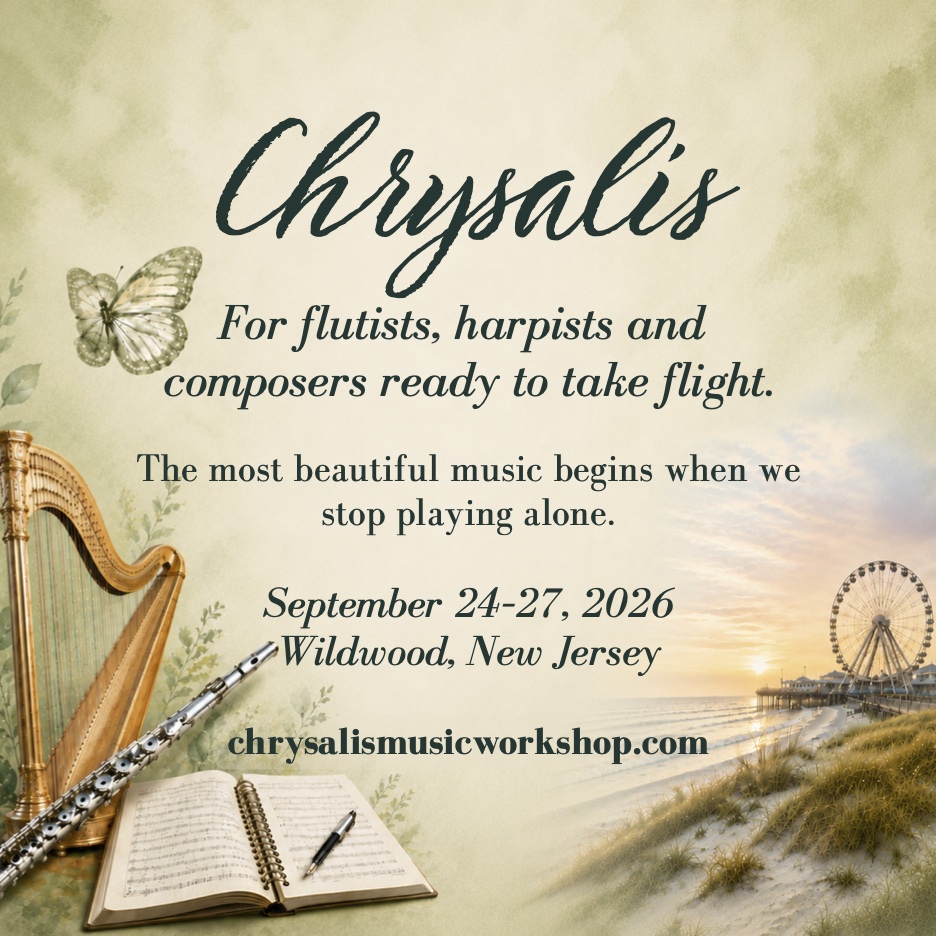
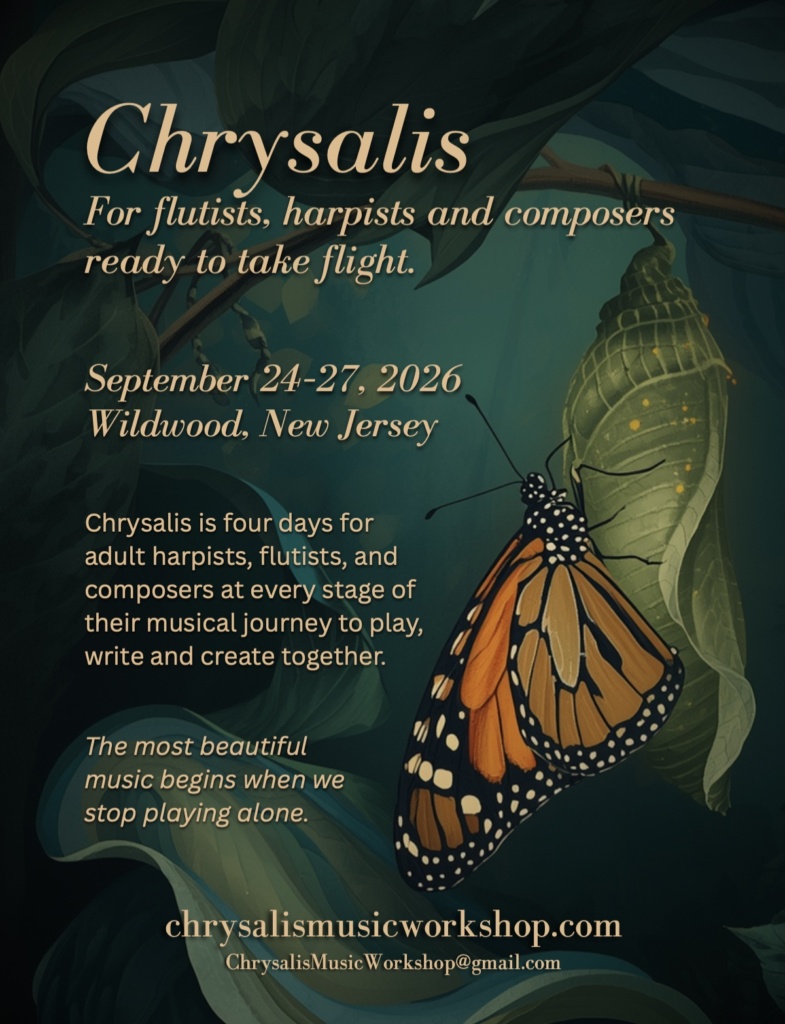
Chrysalis Music Workshop is for flutists, harpists and composers ready to take flight. September 24-27, 2026 in Wildwood, New Jersy. Chrysalis is four days for adult harpists, flutists, and composers at every stage of their musical journey to play, write, and create together. The most beautiful music begins when we stop playing alone.
What inspired you to create a workshop that brings together flutists, harpists, and composers in one collaborative environment?
Anne Sullivan and I have been a chamber music duo for 40 years! In that time, we have set up many retreats and events that cater to young players. Now, we find that adult musicians are looking for ways to play together in a friendly, supportive atmosphere. Adding a professional composer as well as adult composers to the mix will create a new dimension for all.
The flute and harp have a long and beautiful musical partnership. What makes this combination so compelling for performers and audiences alike? The combination presents a compelling contrast of musical sounds. On the one hand, the harp has percussive qualities (among others!) while the flute can sail with legato phrasing. Then there is the combination of tone. Sometimes Anne and I are told people can’t hear the difference between the two instruments.
Was there a particular experience in your career that sparked the idea for this event?
Both Anne and I present retreats for adult flutists and harpists that have good followings. What could add more to a retreat than the opportunity to work with composer to create a unique new work? Coaching by a professional composer and performers make this an unforgettable experience!
How has your own journey as a flutist influenced the design and goals of the workshop?
Good question! Early on I had a great career as an orchestral freelancer in the Mid-Atlantic area. When I began working with Anne, I realized that in many large ensembles I felt like a cog in a wheel. When the duo plays, I can give everything I have, with freedom and creativity, to the performance.
What can participants expect during the four days in Wildwood?
Lots of music making. A strong component in this workshop is placing each part in its context. This is complex, in that not only the importance of working from the score, but the understanding the context of the work in the composer’s output and influence. The opportunity to work with the creation of a new work is central to the workshop, something unique to retreats like this.
How is this workshop different from traditional flute festivals or composer residencies?
In this workshop a beautifully nuanced phrase has just as much, more, value than sheer technique. Of course, technique is important, but at the expense of music making. The composers present will keep this perspective.
Why was it important to include composers as active participants rather than simply featuring existing repertoire?
Composers think on an entirely different level than performers. For the composer, receiving feedback from musicians about what they have written is immensely important
and instructive. For the playing musicians, working with a composer to make sure the outcome is what they envisioned is incredibly rewarding.
What opportunities will performers have to collaborate directly with composers during the event?
Lots of opportunities. Works are being composed now for the event for large ensemble as well as duos and solos.
Will new works be created or premiered as part of the workshop experience?
Absolutely!
How do you envision the creative process unfolding when composers, flutists, and harpists work side-by-side?
Most composers understand the flute and its possibilities and limitations. The harp is a bit more complicated to write for. One thing I do know, the rapid modulations are not the harpists’ best friend!! Contemporary music can sometimes seem intimidating to performers. How does this workshop help musicians feel more comfortable engaging with living composers? Recently, tonality has come into the vocabulary of contemporary composers, as is the concept of beauty. This music is understandable for the performer as well to the listener on the first hearing.
What advice would you give performers who are interested in commissioning new works but aren't sure where to begin?
First: find a composer whose music you love, and inspires you. Second: Be realistic: what is the fee? This is available often through the publisher. Determine how the money will be raised. 3. Contact the composer through their publisher. Know how long you want the piece to be, orchestration, what the scope is, and set a schedule. 4. Be patient 5. Work with the composer on sketches, development. 6. Make sure you have a premiere scheduled, and a recording.
What qualities make a performer-composer collaboration particularly successful?
Shared values, trust, mutual admiration. Finally: communication!
Have there been any memorable commissioning projects in your own career that influenced your thinking?
I am so fortunate to have had several wonderful commissioning projects come my way. In 1996, Anne Sullivan and I commissioned Lowell Liebermann to write Sonata for Flute and Harp, Op 57 for us. (That’s an article in itself.) Then we have a fabulous commission by Daniel Dorff: Serenade for Flute and Harp that was inspired by the music of Solange. And more recently, with Louis deLise, DMA. I commissioned Louis to write a work for flute and vibraphone which was premiered at a National Flute Association Convention and received an award! More recently, Louis has written a set of 12 Miniatures. These works are approachable and at the same, time very sophisticated. Perfect for Chrysalis!
What role do you believe performers play in shaping the future of the repertoire?
It is very important to give back. Engage in the creation of new work, maybe for larger ensembles. It is incredibly rewarding to shepherd a new work into the repertoire.
Are there particular composers or pieces for flute and harp that have inspired you throughout your career?
Music originally for flute and harp includes Carmen Petrabacatol, Jennifer Higdon, Lowell Liebermann, Louis Spohr, Persichetti, and Daniel Dorff and Louis DeLise. It is time for Valarie Coleman Nicole Chamberlin to find out about flute and harp! Kevin Puts is writing very interesting music as well.
How can harpists and flutists develop a stronger hamber music partnership?
Another great question!
Communicate clearly, directly. Learn not to take musical criticism personally. Trust each other musically or otherwise. Respect the music and each other.
Beyond technical skills, what do you hope participants will gain from the workshop?
This was discussed this week: the joy of making music together, finding each other in a phrase, finding the place where the whole is more than the sum of the parts.
How important is creativity and entrepreneurship for today's young musicians?
This is both easier and more difficult in 2026. The social media opportunities are amazing, if crowded. Right now, in the US there is a resistance to the fine arts. Learning a way around that is a tough road.
What advice would you offer emerging artists looking to create their own innovative musical projects?
Know your value. Keep that in front of you. Remember that early on you are building a career and that it takes little steps accumulating to better opportunities. You never know who is in the audience. Play to them.
How do you foster an atmosphere where participants feel comfortable taking artistic risks?
Another great question. It is made clear that the weakest players have the most courage in the retreats Anne and I sponsor and deserve great respect. This is emphasized. We celebrate achievements, minimize mistakes. Fast does not make best…
What has surprised you most about musicians when they are given opportunities to collaborate creatively?
They come alive! The joy is apparent. Working things out becomes a joy. It radiates!
Why did you choose Wildwood, New Jersey, as the home for this workshop?
The Jersey Shore during the end of September is wonderful. We know several of our participants will be bringing spouses. They will have lots to do! There is something freeing about the ocean.
How does the setting contribute to the artistic experience?
The setting is relaxed, open, calming. The Wildwood Convention Center is on the beach! What fun to take a break and dip your toes into the water??
What role does community-building play in the workshop's mission?
Both micro and macro. Micro in that the goal is for musicians to form ensembles. Macro is to reach out to the communities from which the participants come and create similar events.
Do you hope this event will become an annual gathering for performers and composers? By all means!!
What are your long-term hopes for this workshop and its impact on the flute, harp, and composition communities?
Inspiration! Openness to new experiences, forms of communication. We aim to grow ensembles and especially new repertoire.
If you could see one lasting outcome emerge from this year's workshop, what would it be?
Participants discovering joy in collaboration on several different levels.
Are there plans to expand the program or introduce additional collaborative opportunities in the future?
Absolutely!! Stay tuned, and you will be the first to know!
What would you say to a flutist, harpist, or composer who is considering attending but is still on the fence?
This isn't a master-soloist conference where you sit in the back and watch. It's a working workshop. You'll be coached. You'll be paired with a harpist. You'll workshop new pieces with the composers who wrote them. You'll discover repertoire that may be entirely new to you — or simply new to your stand
The workshop centers on collaboration, creativity, and connection.
What does musical collaboration mean to you personally, and why is it more important than ever in today's musical world?
For me personally, collaboration. It means taking care of ego at home and preparing carefully. Approaching a musical event openly, with trust, and a desire to communicate the joy in the performance to the audience. It also means keeping in perspective the 3 collaborative forces in the event. First the composer: the creator. Next the performer: the re-creator. Finally: the audience: for whom all of this is about