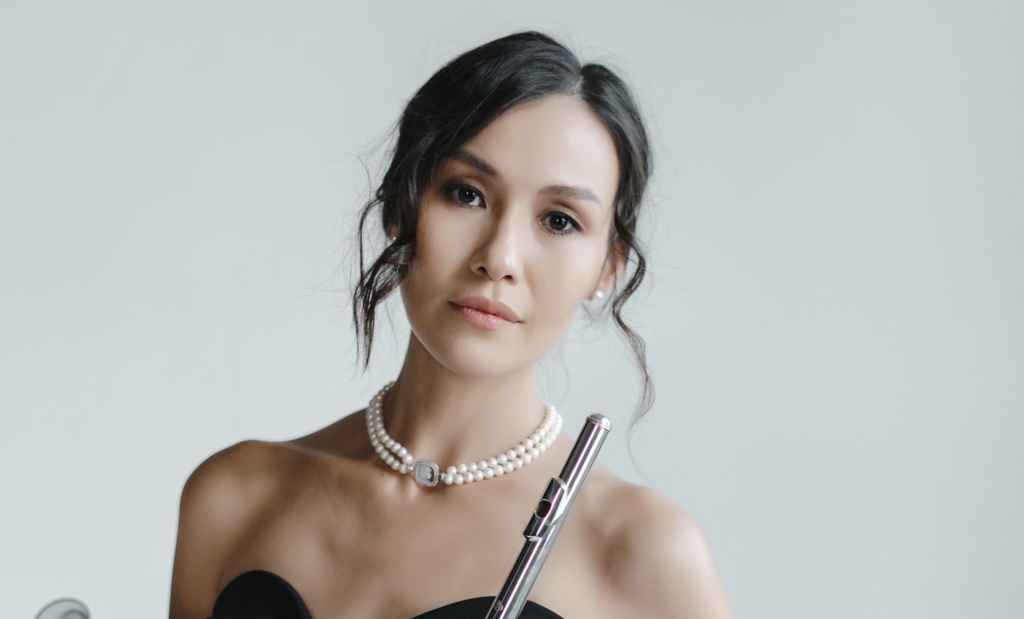
Flute Life in Kazakhstan with Zhanar Zheltyrguzov
Can you tell us a little about the Flute Music Scene in Kazakhstan?
Kazakhstan has a vibrant and rapidly developing flute community. The level of young flutists has grown significantly and more students are pursuing international education and careers. We have strong conservatory traditions, active orchestras, and increasing international collaboration through festivals, competitions, and masterclasses.
What can you tell us about the international events organized for flutists in Kazakhstan?
Kazakhstan has a growing and increasingly international flute community, supported by dedicated educators, performers, and organizations that have worked for decades to develop wind performance and music education.
Kazakhstan hosts international competitions for wind players. One of these competitions is dedicated to the memory and legacy of Professor Kairolla Zhumakenov, celebrating his contribution to the profession and supporting young musicians.
He was one of the most significant figures in the development of flute performance in Kazakhstan. He made an enormous contribution to the growth of wind music education in the country and inspired generations of flutists. He was also a member of the National Flute Association in the United States and, most importantly for me, he was my teacher. Because of that, opening a new chapter of my own career in America feels especially meaningful and symbolic. In many ways, it feels like a continuation of a connection that he helped establish years ago.
In recent years, the international flute scene in Kazakhstan has expanded significantly. Thanks to the efforts of Yerzhan Kushanov, a graduate of the Paris Conservatory, the International Flute Academy was established and successfully brought together leading flutists from Kazakhstan, the CIS countries, and Europe. Distinguished artists such as Eduard Belmar (Germany) and Irina Stachinskaya (Russia) shared their expertise through masterclasses and performances.
The following year, the Academy expanded its focus beyond the flute to include all wind instruments. International artists including Julien Luc (France), Benoît Cutris (France), Yo Matsushita (Japan), and Jasulan Abdykalykov (Kazakhstan) joined the faculty, creating a unique platform for artistic exchange, professional development, and international collaboration.
What do you like best about performing?
Recently, I performed at the Apollo Art Festival Hall, and one of the central pieces in my program was Concertino by Cécile Chaminade. On the surface, it is a brilliant, virtuosic, very “beautiful” piece — the kind of work that immediately showcases the performer. But for me, it is never enough to stay only on that surface. I always feel the need to understand what lives behind the notes, what emotional world the composer is speaking from.
Interestingly, I could not find a detailed story behind its creation. It was written as a competition piece, designed to demonstrate technical mastery. But in my own process of searching, I began to look beyond the music itself and into Chaminade’s life. And there I discovered something that completely changed my interpretation: the story of a woman composing and building her voice in a musical world that was, at that time, largely dominated by men.
From that perspective, the music started to feel very different to me. And this is what I love about performing. Music is never fixed. It changes depending on who you are when you play it, what you have lived through, and what you are able to hear beneath the notes.
What are your goals personally and professionally?
One of my main professional priorities right now is a project called “Musician in the Modern World. It grew out of my work with students and my desire to support the next generation of musicians as they navigate an increasingly complex and fast-changing career landscape.
Working closely with young musicians, I noticed that technical training alone is no longer enough. Today’s artists need a broader understanding of how to build a sustainable and meaningful professional path — one that includes artistic identity, communication, adaptability, and awareness of global opportunities.
At this stage, my goal is to continue developing this initiative, expand its reach, and create resources that can genuinely support musicians in shaping thoughtful and resilient careers.
Who were your music mentors? And what did you learn from them?
My first teacher was Kairolla Zhumakenov. He gave me all the essential foundations — breath control, sound production, and, most importantly, a deep understanding and love for music. Beyond that, because he was such a significant figure in Kazakh culture, he became a role model in a much broader sense. From him I learned how to respect and value people, how to stay open to new projects and opportunities, and how important it is not to stop at what has already been achieved.
My next teacher was Alexander Taraskin. Recognized as one of Professor Zhumakenov’s most outstanding students, he later continued his musical education in Zurich under the guidance of Professor Philippe Racine. Studying with him was an important stage in both my technical and artistic development. Thanks to his guidance, I developed a flexible and reliable embouchure that has remained the foundation of my playing ever since. I am deeply grateful to him for that stability and freedom in my playing.
My mentor in America became Stacey Pelinka, a student of Timothy Day and a graduate of the San Francisco Conservatory of Music. She is widely known for her work in contemporary chamber music, which is exactly the reason I came to study with her. She helped me develop a deeper understanding of the language and aesthetics of contemporary flute music. I am deeply grateful for her mentorship and for the opportunity to work with her.
What 3 things would you offer as advice for a young flutist?
1.Learn to listen to yourself before you listen to the sound. The flute quickly reveals your inner state. If there is anxiety, rushing, or a desire to please, it immediately becomes audible.
2. Don’t separate breath from meaning. Breath is not only a physical mechanism or support. It reflects how you live inside the musical phrase. When there is meaning, breath naturally becomes an extension of thought.
3. Don’t compare your path to others. Every flutist develops at their own pace, with their own strengths and moments of searching. Comparison often pulls you away from your own process and creates tension in the music.