Winds & Flow – Music Retreats in Asturias, Spain
Interview Questions: Winds & Flow – Music Retreats in Asturias
- What inspired you to create Winds & Flow: Music Retreats in Asturias?
The idea came from my own journey as a flutist. During my professional training, I realised that musicians spend countless hours developing their technique, but very little time learning how to take care of themselves, both physically and mentally. Like many musicians, I experienced first-hand the physical and mental demands of a professional career. Discovering yoga completely changed my relationship with music. It helped me recover, manage stress and reconnect with the joy of playing.
Later, after moving into cultural project management while continuing to play the flute simply for the love of it, I found it surprisingly difficult to find opportunities to keep learning, playing in ensembles and enjoying music as an adult. I also met many adult learners who were passionate about music but struggled to find inspiring, high-quality courses where they truly felt welcome, regardless of their age or level.
At the same time, many of the courses I attended were focused almost entirely on musical practice. I often felt something was missing: the chance to really experience the place itself. I wanted a retreat where participants could not only make music, but also spend time in nature, discover the local culture and gastronomy and experience the destination through all their senses. I wanted the place to become part of the learning experience.
Winds & Flow grew from all of these experiences. I wanted to create an inclusive and welcoming space where adults could continue growing as musicians throughout their lives, without pressure or competition. A place to learn, share, reconnect with nature and simply enjoy making music together. I also wanted to bring together an international community of flutists. One of the most rewarding parts of every retreat is seeing people from different countries, musical backgrounds and generations learning from one another, creating genuine friendships and leaving inspired not only by the music, but also by the people they met and the place they shared together.
- How did the idea of combining music, wellness, and nature come together?
For me, music, wellbeing and nature have always been intrinsically connected. As musicians, our body is our instrument. We rely on our breath, our posture, our physical and mental balance every single day, yet very few of us are actually taught how to take care of those things during our musical education.
My own experience with yoga first opened that door for me. Later, through working with musicians and exploring practices such as breathwork and qigong, I realised there are many different ways to develop body awareness, improve breathing, release unnecessary tension and reconnect with ourselves. These practices don't replace musical training, they support it.
Sometimes I think we've forgotten something that has always been there. Throughout history, music has been closely connected to nature, community and human wellbeing. Even as classical musicians, I believe we still carry that connection, but modern training often focuses so much on technique and performance that we lose sight of it.
We also know much more today about the importance of musicians' physical and mental wellbeing. We often recognise the power of music to improve other people's lives, but we don't always give ourselves the same care. Winds & Flow is my way of bringing all these elements back together. It isn't about adding wellness activities to a music course. It's about creating an experience where music, nature, personal wellbeing and meaningful human connection naturally support one another.
- Why was Asturias chosen as the home for these retreats?
For years, I had this idea in my mind, wondering where such a retreat could take place. I kept thinking about everything I wanted to bring together: unspoilt nature, the sea, the mountains, music, wellbeing, local culture, wonderful gastronomy and a place that would inspire people to slow down and reconnect.
Then one day, I realised I had been looking too far. Everything I was searching for had always been right in front of me, in my own home, Asturias. Located in the north of Spain, Asturias is very different from the image many people have of the country. Here you'll find dramatic cliffs, ancient forests, small fishing villages, green mountains and a slower pace of life. It's a place where nature is still very much alive.
Our retreat takes place in Cadavedo, a magical village on the Asturian coast, located on the Northern Way of the Camino de Santiago. Surrounded by traditional hórreos, local legends and centuries of history, it has a very special atmosphere that invites you to slow down, breathe and reconnect with yourself and with nature. For me, Asturias isn't just the location of Winds & Flow, it's one of the main reasons the retreat is what it is. I want participants to leave not only having grown as musicians, but also having discovered a different side of Spain through its landscapes, culture, food and people. I believe those memories become just as meaningful as the music itself.
- Your retreats welcome professionals, students, and passionate amateurs. How do you create an environment where musicians of different levels feel equally valued?
From the very beginning, I wanted Winds & Flow to be a place where people feel comfortable being themselves, regardless of their age, background or musical level. We all arrive with different experiences and everyone has something valuable to contribute. Professional musicians often inspire others with their experience, while enthusiastic amateurs remind us of something equally important: the joy, curiosity and love for making music. It's a wonderful exchange and I truly believe everyone learns from one another.
The same is true of the diversity of countries, musical backgrounds and generations. One of the things that made me happiest during the first activities was seeing more than 40 years between our youngest and oldest participants. Welcoming musicians in their sixties and beyond is something we're especially proud of. Their enthusiasm, generosity and life experience enrich the whole group, while younger participants bring fresh ideas and energy. Together, they create conversations and friendships that simply wouldn't happen in a more traditional course.
Keeping our groups small allows us to get to know each participant personally and adapt the experience to their own goals. There is no sense of competition or comparison, just a welcoming, supportive environment where everyone is encouraged to grow at their own pace.
For us, success isn't about everyone reaching the same level. It's about everyone leaving feeling more inspired, more confident and even more connected to music than when they arrived.
- What makes learning in a retreat setting different from traditional masterclasses or conservatory training?
Participants enjoy a varied musical programme, including individual lessons, ensemble rehearsals, workshops, performances and sessions with different guest flute artists throughout the week. Each guest artist brings their own musical background, teaching style and artistic perspective, giving participants the opportunity to learn from several inspiring professionals in one retreat. So yes, in many ways it is also a music course. But the word retreat is just as important, because it reflects the spirit of Winds & Flow.
A retreat gives us the chance to step away from our everyday routines, slow down and reconnect. There is time to practise, but also time to breathe, walk by the sea, share meals, discover the local culture and simply enjoy making music without constantly rushing from one activity to the next.
I don't believe that the most meaningful learning only happens inside the lesson. Some of the most memorable moments take place during conversations after rehearsals, evening open mic sessions, shared meals or quiet moments in nature. Those experiences become part of the music too. When participants return home, they leave not only with new musical ideas and artistic inspiration, but also feeling more balanced, refreshed and excited to keep playing.
- How do you encourage participants to learn without pressure while still experiencing meaningful artistic growth?
I don't believe that pressure is what makes people learn. In my experience, people grow the most when they feel comfortable enough to be curious, ask questions and even make mistakes. Many of our participants tell us that, in their everyday musical life, they don't always have the opportunity to challenge themselves. Some have never been encouraged to play first flute, others don't feel confident joining more advanced ensembles and many adult musicians simply don't have regular opportunities to make music with others. Over time, this can affect confidence just as much as musical development.
At the same time, we don't lower our artistic standards. Participants work with inspiring guest artists, receive individual feedback and are encouraged to challenge themselves throughout the week by exploring different repertoire. The difference is that this happens in a positive, welcoming environment, where growth comes from motivation instead of pressure.
One of the most rewarding moments is seeing participants discover they are capable of much more than they believed. They leave not only with new musical ideas and technical tools, but also with greater confidence, renewed motivation and a genuine excitement to keep playing.
- What kinds of musical activities can participants expect during a typical retreat?
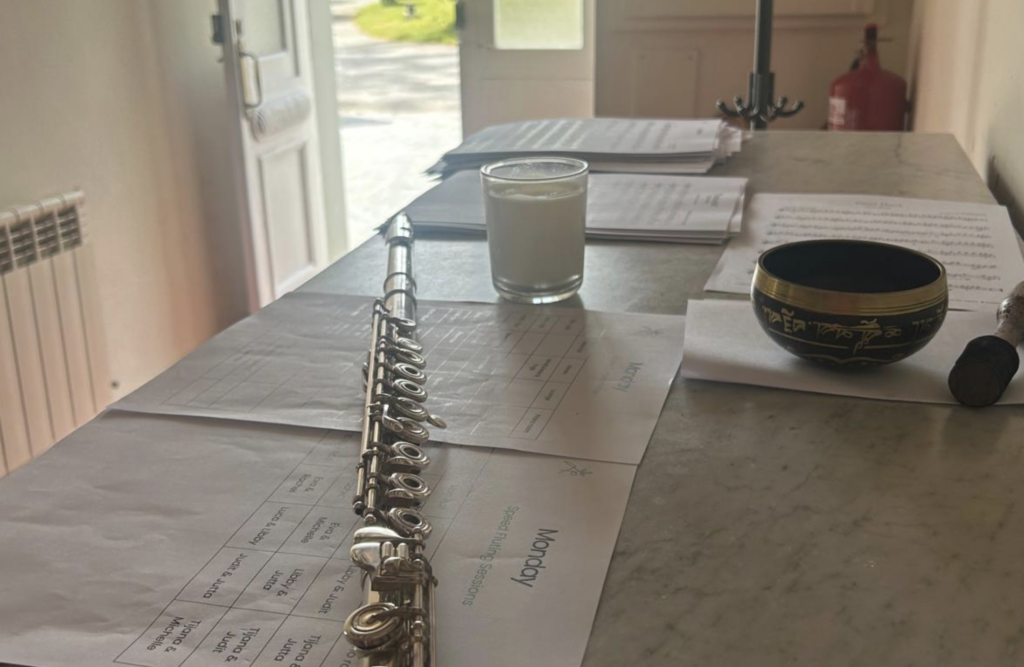
Each day begins gently, with yoga, breathing exercises and meditation, followed by a generous breakfast made with fresh local products. Afterwards, we start the musical day with our Speed Fluting Sessions, a fun and relaxed way to warm up, challenge yourself through short musical activities and, at the same time, get to know the other participants.
Throughout the day, participants work in different chamber music formations, from trios and quartets to our flute ensemble and full flute choir, bringing everyone together to make music as a group. Every participant also receives at least one individual lesson during the retreat, providing personalised guidance and feedback.
In the afternoons, we welcome a variety of guest flutists—including internationally recognised soloists, orchestral musicians and conservatoire professors—who lead workshops and masterclasses, each sharing their own artistic perspective and professional experience. Participants also have the opportunity to meet a specialist flute luthier, who checks and adjusts their instruments, offers practical advice on maintenance and helps ensure every flute is in the best possible condition.
After dinner comes one of the most magical moments of the retreat: our Open Mic Sessions, usually held beneath a traditional Asturian hórreo. These informal evenings are open to everyone and to every style of music. There is no pressure—just a welcoming atmosphere where participants feel encouraged to perform, experiment, improvise, collaborate and simply enjoy making music together.
The week concludes with rehearsals alongside our pianist and a final public concert in a conservatoire or another cultural venue in the surrounding area. It is a wonderful opportunity to share everything that has been explored during the week, connect with the local community and experience performing in a beautiful setting.
- Have you observed changes in participants’ confidence, artistry, or mindset after attending the retreat?
Absolutely. One of the most rewarding parts of Winds & Flow is seeing what happens over the course of just a few days. Many participants arrive feeling nervous, doubting their abilities or comparing themselves to others. By the end of the week, they are much more relaxed, confident and willing to step outside their comfort zone. For some, that means performing at an Open Mic for the first time. For others, it means joining an ensemble again after many years, trying new repertoire or simply rediscovering the joy of playing without fear of making mistakes.
What makes me happiest is hearing participants say, "I hadn't enjoyed playing like this for years," or, "I can't wait to go home and keep practising." That kind of motivation is incredibly valuable because it lasts long after the retreat has finished.
I also think people leave with a different perspective. They realise that musical growth doesn't only happen in the practice room. It happens through conversations, walks in nature, yoga sessions, taking a swim in the Cantabrian Sea, listening to others and feeling part of a supportive international community. In the end, that's what Winds & Flow is really about.
- How important is the sense of community that develops among participants from different countries and backgrounds?
I think it's one of the most special parts of Winds & Flow. For example, at our Flutes Summer Flow 2026 retreat, we welcomed participants from Australia, Austria, Hungary, the Netherlands, Serbia, Spain, the United Kingdom and the United States. Seeing people from so many different countries, musical backgrounds and generations come together in one small village in Asturias was something truly special.
Every participant brings a different story, a different way of learning and a different musical perspective. Some have spent their lives performing professionally, while others are rediscovering the flute after many years or have only recently started playing as adults. Instead of those differences creating barriers, they become one of the greatest strengths of the retreat. Everyone has something to learn and something to share.
I also love seeing how quickly friendships develop. People arrive as strangers, but by the end of the week they're exploring Asturias and Spain together, making music long after the scheduled sessions have finished and already talking about meeting again. One of my favourite things is that this sense of community doesn't end when the retreat is over. We have a very active WhatsApp group that starts before participants even arrive and continues long afterwards. It's where people introduce themselves before the retreat, share photos and memories, exchange ideas, celebrate each other's achievements, ask for advice and stay connected across countries.
We also have a shared music folder where everyone can upload pieces they love or repertoire they'd like to play at future editions. I love seeing participants inspiring one another with new discoveries and helping shape the musical programme together.
- Do you have any memorable stories of friendships, collaborations, or musical projects that began at Winds & Flow?
One of the most memorable collaborations took place during Flutes Summer Flow 2026, when British flutist and composer Katrina Penman, now based in Spain, joined us for the final three days of the retreat. Together, we prepared one of her original works for flute ensemble. Having the composer herself explain the inspiration behind the piece, rehearse with us and conduct the performance was an unforgettable experience. The week ended with a beautiful recital of her music, creating a very special connection between the performers, the composer and the audience.
Another collaboration I'm especially proud of is with Enrique Pernía, Spain's only certified Brannen Brothers Flutes technician. He joins the retreat to check participants' instruments, make adjustments and share practical advice on flute care. It's a unique opportunity that many flutists rarely have access to.
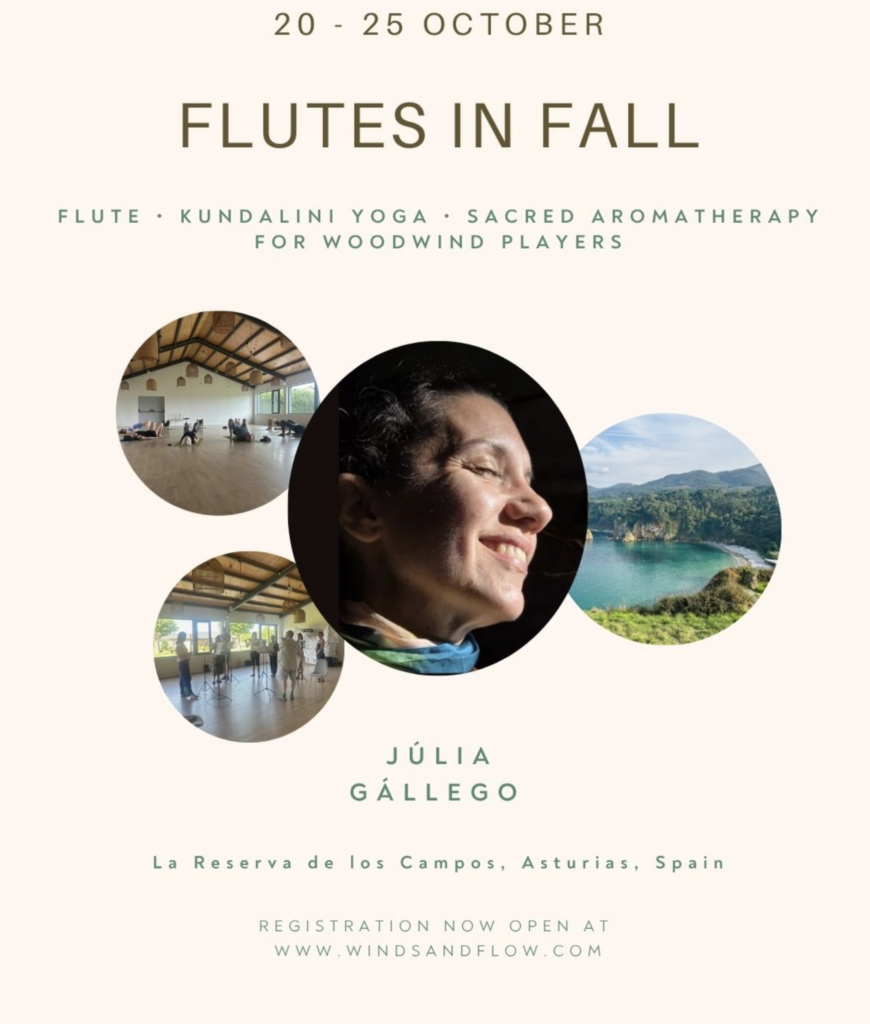
This October we're also delighted to welcome Júlia Gállego as our guest teacher. An internationally recognised flutist, Professor at the Escola Superior de Música de Catalunya (ESMUC) and the Conservatori Superior de Música del Liceu in Barcelona, Júlia is also a certified Kundalini Yoga instructor, a Sacred Aromatherapy practitioner and the creator of the holistic programme for musicians SomaKardioEnergeia in Harmonia. Her unique combination of artistic excellence and wellbeing perfectly reflects the philosophy of Winds & Flow.
Beyond the musical collaborations, one of our priorities has always been to work closely with the local community. We collaborate with local businesses and producers whenever possible, and many of the ingredients used throughout the week come from small local suppliers, several of them based in the village itself. We want participants not only to discover Asturias through its landscapes, but also through its people, traditions and gastronomy.
- Your retreats feature a core team plus guest musicians and yoga instructors. How do you choose the professionals who join each program?
Finding the right people is probably one of the most important parts of organising each retreat. Of course, we look for professionals with strong artistic careers and recognised teaching experience. But that's only the starting point. What really matters is finding people who genuinely enjoy sharing their knowledge, are approachable and create a supportive atmosphere where every participant feels comfortable, regardless of their level or background.
The same is true for our wellbeing team. We work with professionals who understand the specific needs of musicians and who see practices such as Kundalini Yoga, breathwork, Qigong and Sacred Aromatherapy as valuable tools to support artistic performance, health and creativity.
Although the flute is at the heart of Winds & Flow, we also love welcoming musicians from other instruments. Collaborating with artists beyond the flute world brings fresh ideas, different ways of listening and making music, and reminds us that there is always something new to learn from one another. Some of our most inspiring moments have come from these unexpected musical encounters.
- What are your hopes for the future of Winds & Flow?
My biggest hope is that Winds & Flow continues to grow while staying true to the values that inspired it from the very beginning. I'd love to continue building an international community of flutists who share not only a passion for music, but also a connection with nature, wellbeing and one another. A community where people keep meeting again, supporting each other and growing together long after each retreat has ended.
Another important goal is to help make physical and mental wellbeing a more natural part of musical education and professional life. Whether someone is an amateur, a student or a professional musician, I believe we all deserve to learn how to look after ourselves. I hope to keep introducing holistic practices and new approaches that can help musicians perform, learn and enjoy music in a healthier and more sustainable way.
I also want Winds & Flow to continue promoting inclusive, lifelong learning, creating inspiring opportunities for adults of all ages to develop musically without pressure or unnecessary competition. Looking ahead, I'd love to welcome other woodwind instruments to future editions, develop new collaborations with inspiring artists and wellbeing professionals and explore new retreat locations while keeping Asturias at the heart of the project.
- If Winds & Flow could be described in just three words, what would they be—and why?
Connect. With people from different countries and cultures, with the local community, with the place itself and with new ideas and perspectives.
Reconnect. With yourself, with nature, with the joy of making music and with the reasons you started playing in the first place.
Enjoy. Enjoy making music, laughter, beautiful landscapes, shared moments and everything that happens in between.