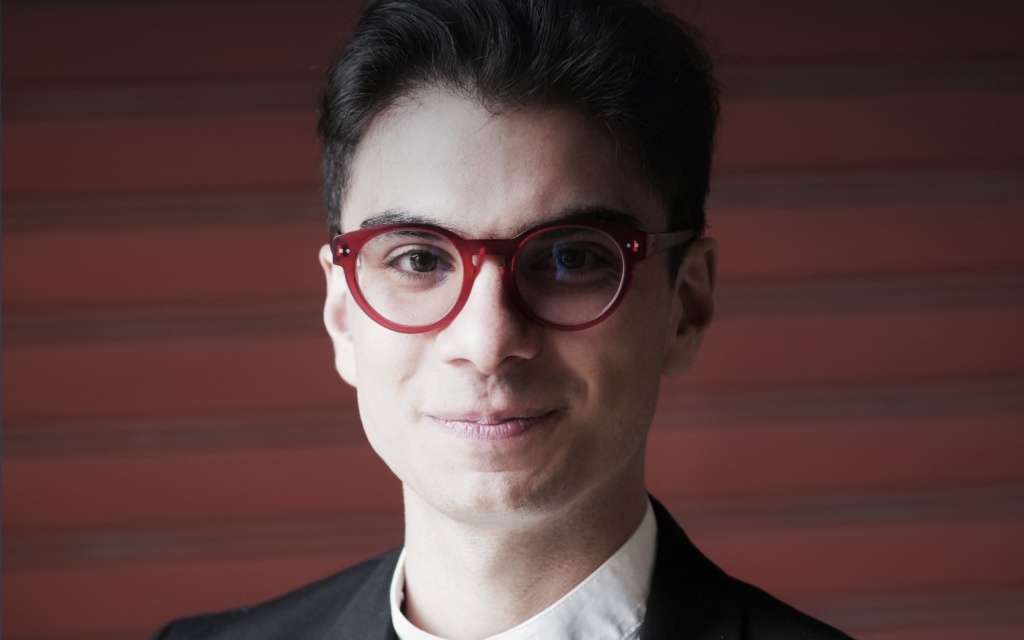
Carl Nielsen First Prize Winner 2026 Federico Altare
Music is my deepest source of inspiration, my deepest commitment and my most intimate way of expression. It is where I start — everything else grows from it. The flute is my first and truest voice; I conduct because it lets me speak with an orchestra rather than to it; I compose because, eventually, I wanted to say something entirely my own, without passing through anyone else's language to say it.
What keeps me questioning myself, improving, and searching for new ways to make music is the pursuit of those rare, unrepeatable instants that exist only in live performance — when art, history, performance and spectacle converge into a single moment of communion between the stage and the audience, never to happen quite the same way again. I strive for those moments, and the human connection that only music can create.
I move between historically informed performance and the most demanding contemporary repertoire without treating them as opposites — both demand the same thing: listening closely enough that the music tells me what it needs, rather than the other way around.
Can you give us 5 career highlights?
Difficult to chose only 5! I would feel bad for all the great moments that I wouldn’t name.. but I think I would mention performing Mahler 9th symphony in Musikverein, being the first time I was performing a solo from the orchestral repertoire, and do it in such a great hall after a big tournee was truly amazing; still speaking about orchestral solo, performing the entire ballet of The Firebird in concert version under Klaus Mäkela was a great moment, performing at Verbier Festival and also live on medici… some pressure but also a lot of honour to play in such circumstances! Then I have to mention a tournee with Les Arts Florissants (one of the leading French baroque ensembles of all time) under the direction of its founder, William Christie, performing Campra’s Miserere and Requiem. Then as solo performances, for sure there is “...Explosante-Fixe…” by Pierre Boulez, played for the celebrations of his 100th anniversary at IRCAM, with the astonishing Ensemble Intercontemporain; and last but not least, my Nielsen Concerto performance last June in Odense, were I developed a quick but great relation with the Odense Symphony Orchestra, and ultimately led to my Nielsen Competition prize and to the Orchestra Prize.
-How about 3 pivotal moments that were essential to creating the artist that you've become?
I like to imagine that my artistry and my identity as an artist are not fixed, but still in motion, and I look forward to see what I will become in the future. However, I can recall some moments that really made me switch mindset, or set me on a new path. For sure, deciding to leave my family and my friends behind and move to a new country (the Netherlands, and then France) was essential to the personality I would go on and develop; I was very young, but still I was convinced that moving was the best decision, and it ultimately turned out alright! Then I would say that the moment I arrived in Paris, and started my studies at the CNSMDP (Paris conservatoire) had a great influence on who I was; learning a new language, meeting new people, starting to learn with new teachers (such as Sophie Cherrier), but also discover a new musical environment, as the Parisian musical life is so varied and rich, and especially get to play a lot of music with friends and colleagues, for example my partnership with pianist Martin Jaspard (together with whom I graduated in chamber music): all of this encounters really shaped how I see music and how I imagine what art should mean. And finally, more flutistically speaking, my encounter with Historically Informed Practice and the Traverso playing: this really opened doors and hallways in my mind on the way I now look at music performance and music history, as well as finding new ways to express myself not only via new instruments (baroque, classical, romantic flutes…) but through an ever-changing palette of sounds and colours: HIP is still making me look at things from new perspectives, and I love how fresh and rejuvenating this work is!
-What do you like best about performing?
I love that when performing people are just truly themselves: there is no hiding, there is no faking, the personality of every player just comes trough when one is playing. It is like getting to know someone more intimately, but in a millisecond. This is also the reason why I like so much performing with others, and even if I have to assume a more “solistic” role I try to communicate with the other musicians, making music with them and being on the same artistic level, since I really want to hear who they are and feel accepted in showing who I am. Performing should therefore be something that everybody is allowed to do and accepted, like expressing opinion: it ultimately is the best way of exercise our right to be ourselves!
-CD releases?
I am very excited for my first project to come out on the 23rd of October! The CD is called “Shadows of Silence”, and it tries to put together all the aspects of my recent artistic work in a one-hour timetravel across music styles, diapasons, playing techniques and flute history. The CD contains Michael Jarrell’s Flute Concerto “…un temps de silence…”, in its ensemble version (reduced from the symphonic one) an it is also its premiere CD recording; then there is C.P.E. Bach’s G major, performed with period instruments (at an astonishing low diapason of A=392 Hz !) where I also lead the ensemble from the flute; and last but not least, a newly commissioned piece! “Hymne et Quinconce”, written by Alexandre Jamar, that tries to bridge the gaps between “silences”, and puts together modern and period instruments, in a dialogue between playing techniques and styles. I am very excited for this release, and also very grateful for all the people that worked on this project, from all the friends that joined me on this adventure to the team that made a huge stretch for getting to record such a crazy repertoire!
-What does your schedule look like for the next 6 months?
I am so grateful that in the upcoming future I get to explore even more what I want to be as a musician: I’ll have to manage a busy concert schedule, filled with recitals, my first masterclass, orchestra appearences, I’ll be in recording studio again for a flute and live electronic project, ensemble playing and historical performance practice (preparing Beethoven’s symphonies on period instruments for next year’s release with Insula Orchestra for Harmonia Mundi); but I am also taking up conducting lessons, and finishing my master’s degree in historical flute! So I’ll have some conducting performances, my very first concert without the flute but only with my baton in February… and a lot of flutes to explore, especially extending into romantic flute performance from the end of 19th century. Ultimately, many travels, many great colleagues, lots and lots of music… what could I ask more?
-What are your goals personally? Professionally?
I am convinced that all I want to achieve is to be free to be myself, personally and professionally. Therefore I am still looking who and what do I want to be, but I am also trying to do it without compromising my values and ideas. Accepting the right gig, never saying yes to something that would not suit your play style or something that you are not sure you will be able to perform at your best… being true to oneself. And this of course, applies also to the personal side of it
-What inspires you the most in life?
I love to meet mew people. It is something that really inspires me and it is one of the most refreshing things we can do as artists: just be nourished from all the different personalities, visions, ideas, opinions there are around us. I also think that we can learn a lot about ourselves when meeting new people, we develop our own personality, and ultimately grow as artists. Also, playing with others is so much better than alone!
-What has been your professional greatest challenge? What has been your personal greatest challenge?
Probably the biggest challenge I had to face and face constantly is reminding myself that whatever I try to do, to dream, to achieve, is worth fighting for. So many times we are trying to convince ourselves that talent is all there is, if you dont achieve quick and fast then it is not worth it, you are not worthy. And that is so so wrong, and yet so difficult to understand. Before going into the Nielsen Competition, I faced a long and difficult period of lows in my life, auto-sabotaging myself and thinking I was not good enough, as a musician, as a person, as a friend, etc… without working on those negative thoughts, those tricky attitude to face, those low moments, you cannot show up for a competition, or not even for a concert, or even a coffee with a friend, and pretend to be yourself. Only by being myself I could step on that stage in Odense and really enjoy what I do, and ultimately it proved to be the right way to go about performing.
We put so much pressure on ourselves all the time, and the greatest challenge is definitely to remind ourselves that whatever your goals are, whatever your dreams, not only you have the right to aim high and go for the stars, but those things are very much worth fighting for. I am very lucky to have great people around me in my life, and I am sorry if many times I cannot make it up to them, but it is important to take care of our mental health, and I would definitely say that fighting whatever negativity it is in my head is much harder than any competition, piece to prepare, audience to perform for; once you gain control over your head, nothing can stop you!
-Who were your music mentors? and what did you learn from them?
I was lucky enough to have great teachers during my studies, and I am thankful to all of them, since everyone shaped me and made me who I am today. I have to mention 4 of them, for sure; Juliette Hurel was my teacher in Rotterdam Conservatory, and she really made me into a true musician; together with Julie Moulin, she thought me how to be curious, how to always question myself and how to reflect on the music rather than reflecting solely on flute technical aspects. Than for sure Patrick Gallois, who mentored me for several occasions in Siena, at the Accademia Chigiana: he contributed to open my eyes and ears towards the Historically Informed Practice, and pushed my curiosity and musicianship even further. Anna Besson then was my teacher for Baroque and Historical Flutes, and she made me fell in love with how varied and colourful all of the early flutes can be. And last but not least, Sophie Cherrier, who was my teacher in Paris Conservatoire and throughout my post-graduate studies, and proved to be a true coach and mentor when it came to chose a career path, pushing me to stay true to myself, and that I am so lucky now to have sometimes as colleague.
-Can you give us 5 quirky, secret, fun, (don't think too much about this) hobbies or passions?
-> I speak 5 languages fluently (italian, English, French, Spanish, Portuguese) and I am going for the 6th one (dutch)
-> I mostly don’t like fruits, currently I am forcing myself to learn to eat bananas
-> I like competitive strategy games like chess or trading card games, I spend way too much time studying those things rather than music...
-> in my free time I like to invent noises and little sounds I can make, my friends call me “professional sound-maker” (in French: bruiteur professionnel)
-> i am very bad with plants, even a cactus could die under my care
-What 3 things would you offer as advice for a young flutist?
1. Learn the importance of practicing etudes in a musical way
2. Never forget that music is ultimately a product of your soul, so be a good human being and you’ll be a good musician. Breath as you speak, and speak as you breath.
3. Never ever, under any circumstances, give up - but you are allowed holiday breaks!