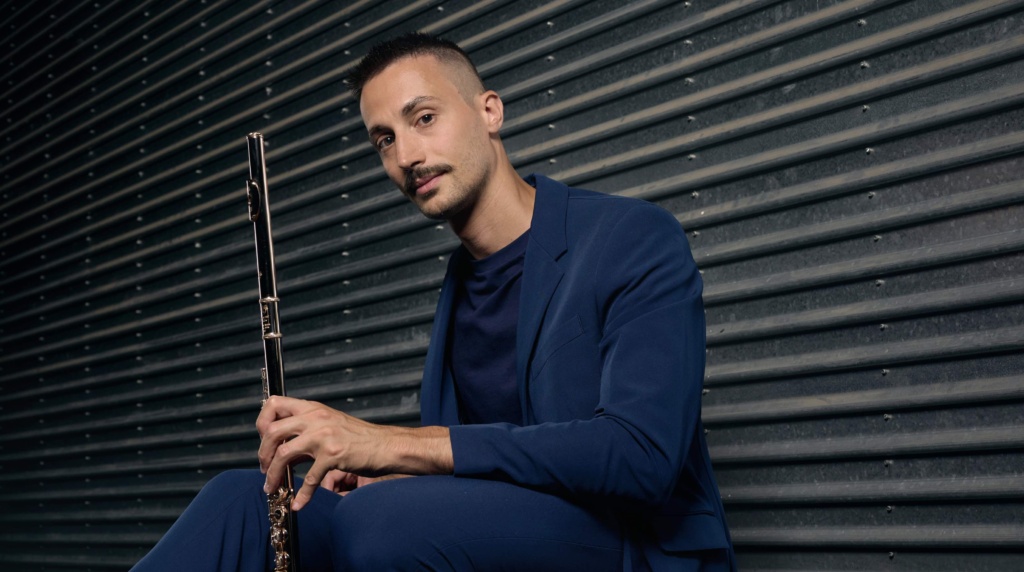
Mario Notaristefano Artist Interview
Mario Notaristefano is the Principal Piccolo of the Staatstheater Braunschweig. He began his studies with Michele Marasco and later continued with Andrea Oliva at the Accademia Nazionale di Santa Cecilia in Rome. A crucial milestone in his artistic development was his work with Mario Caroli, who profoundly influenced his musical growth. Mario has performed with numerous orchestras and ensembles, including the SWR Symphonieorchester, Konzerthausorchester Berlin, NDR Radiophilharmonie, Frankfurter Opern- und Museumsorchester, and Ensemble Aventure.
Passionate about education, has held professorships at the University of the Arts in Bremen and the University for Music Freiburg. Driven by a deep commitment to musical research and interpretation, Mario has also published essays in several journals, including the philosophical review Studi di Estetica (Alma Mater Studiorum University of Bologna), the e-journal De Musica (Department of Philosophy, University of Milan), and the periodical Falaut. Mario is a sponsored artist of Miyazawa Flutes Europe and plays on a 14k Cresta flute
How about 3 pivotal moments that were essential to creating the artist that you've become?
It’s hard to narrow it down, there are countless moments that shaped me, and surely some I will only recognize much later.
Winning the permanent position as Solo Piccolo of the Staatsorchester Braunschweig in 2021 was certainly a turning point. It allowed me to do the work I had always dreamed of. Nothing can really prepare you for such a role, you simply grow into it, and in turn, it transforms you. Another milestone was last season, when I performed the Liebermann Concerto for Piccolo with my orchestra. It was an enormous responsibility, months of hard work, but it became one of the most meaningful memories of my career. Finally, I think of all the colleagues and friends I have met over the years. I know I can always rely on them for advice and honest feedback. Having a community of trust and mutual respect has been invaluable for my growth as a musician and as a person. And I cannot forget the pandemic years, which pushed me into the darkest place of my life. That is when I began a long and painful process of therapy, probably the most valuable step I have ever taken. It sustains me today as a human being and as an artist.
What do you like best about teaching? Masterclasses?
Teaching is for me a wonderful opportunity to experiment, to question both my ideas and those of my students. What I value most is helping them develop awareness, whether physical, musical, technical, or related to intonation. I can offer guidance, but unless it’s truly assimilated and made personal, they will always feel like something external. Art is a process of inner discovery: it is not just about what you do, but about knowing how you do it. Awareness gives you freedom, and with freedom comes choice.
I also believe teaching should be as simple, clear, and effective as possible. Music is already abstract enough, we do not need to make it even more complicated. I remember struggling a lot as a student to understand concepts like breathing or support; everyone would explain them in a different, often confusing way, and I am not sure they really understood themselves. So my motto is: keep it simple. Above all, teaching is a great responsibility. Life cannot be measured by success, neither ours, nor even less that of our students.
What do you like best about performing?
Music has always been a kind of shelter for me, a bubble where I felt protected. Spending so many hours alone practicing inevitably made me confront myself on a deeper level. I try to find inspiration from colleagues and conductors, and I like to go deep into the meaning of a piece, studying the background of the work and the composer, then trying to embody it in sound. Performance can transport us into a different space and time, even if just for a moment, freeing us from the weight of everyday concerns. But there is also another, more tangible side: the artistic world can burn with fragile egos, the need for recognition, and sometimes highly toxic orchestral environments. Yet, as in everything, there’s never just one path, you can always choose your own.
What does your schedule look like for the next 6 months?
This past year has been extremely consuming, so I decided to take a slightly less active period, focusing mainly on orchestra work. In reality, even my idea of a “lighter” schedule still involves quite a lot of music! The theatre season is now almost over, which brings a sense of relief and a bit of space to breathe again. I will still have a few engagements, including some solo concerts featuring Flute Concerto in A minor RV 440 by Antonio Vivaldi. But if I’m completely honest, the commitment I’m most excited about is not on stage: it’s an upcoming holiday in the Maldives, where I’ve planned some diving. I truly can’t wait.
What are your goals personally? Professionally?
Personally, I want to create more space to share with friends and the people closest to me. They ground me, challenge my ideas, and open me to new perspectives. Professionally, I want to keep nurturing and progressing in this passion. But in truth, my job, even though I love it deeply, does not define my identity. I take every opportunity with enthusiasm and responsibility, but I could stop tomorrow without feeling that my life has lost its meaning.
What inspires you the most in life?
Curiosity is what drives me most. I try to do very different things, outside of music as well. Sports and spending time in nature fuel my energy and passion. During my time off, I’ve learned to disconnect completely from work, and that has become essential for me.
What has been your greatest challenge?
Professionally, my biggest challenge was preparing the Liebermann Piccolo Concerto last season. It took me nearly six months of focused and dedicated effort! Personally, my greatest challenge has been understanding who I am beyond all conditioning. What brings awareness is not just being yourself, but learning to understand yourself. Often, you feel out of place simply because you are not even sure what the “place” is anymore. It is a continuous journey of self-discovery.
Who were your music mentors? What did you learn from them?
On the long path of study, we all meet teachers and mentors who leave an imprint. Three people have been particularly important for me:
Michele Marasco, former principal flute of ORT Florence. A rather stern teacher, but an extraordinarily refined flutist, with a unique sense of phrasing and an incredible eye for detail. From him, I learned the importance of precision and nuance.
Andrea Oliva, principal flute of the Orchestra of Santa Cecilia in Rome. An exceptional flutist. When I studied with him, I don’t think it was the right time for me, I couldn’t grasp everything then, but many of his teaching came back to me years later, with even greater clarity. The work we did on sound was incomparable, and I am deeply grateful for it, even if belatedly!
Mario Caroli, professor at the Hochschule für Musik in Freiburg. I studied with him the longest, and he was a very important figure in my journey. A musician of rare sensitivity, he showed me a perspective beyond right or wrong, just deeply personal. His ultra-pianissimos were hypnotic for me, as was his fresh approach to baroque music. For those years he was a reassuring and supportive presence. Of course, such a strong personality could sometimes be overwhelming, so leaving his class was also a necessary step to let my own musical identity fully blossom from what I had learned with him.
Can you give us 4 quirky, secret, fun hobbies or passions?
- I love being in nature, and above all, diving. More than the fish or the corals, what fascinates me most are the infinite shades of blue. It’s one of the things that moves me the most.
- I love cooking, I could spend an entire day in the kitchen.
- I am an avid collector of antiques.
- I keep a dream diary to track my dreams and explore how the unconscious evolves through them.
What 3 things would you offer as advice for a young flutist?
- Put your ego aside. You didn’t start music for that, and if you let ego lead the way, it will only bring frustration.
- Choose your mentor wisely. You need to trust and be inspired by them, but you must also learn to question everything, including yourself. Experiment, shift perspectives, and find your own path. You are unique, not a parrot.
- Define your boundaries, with your instrument, your work, and your teacher. No feedback can truly define who you are. We are constantly exposed to the judgment of teachers, audiences, colleagues, juries. But no person or institution will ever measure your true worth, in success or in failure. If you listen deeply to yourself, the need to please will disappear.
And of course: be curious, about people, about music, about the world. Explore without fear. And remember, nothing replaces solid practice, patience, and a high level of concentration.