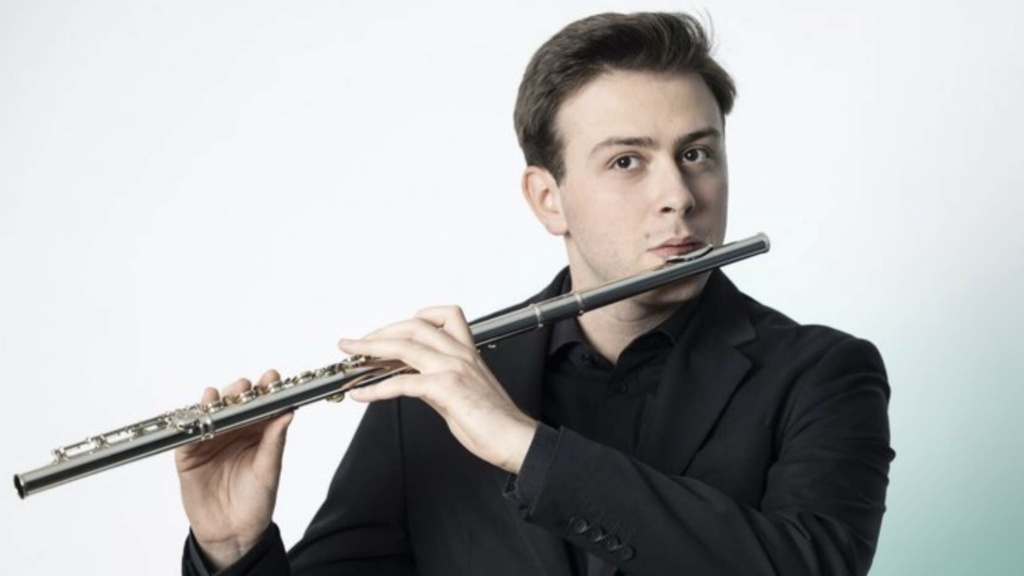
How Lorenzo Messina Reached the Berlin Philharmonic by 24
Lorenzo Messina is a 24-year-old Italian flutist who studied in Italy and Germany and has recently been appointed second flute with the legendary Berliner Philharmoniker. He has performed as principal flutist with orchestras such as the Luxembourg Philharmonic, the Staatsoper Stuttgart and the Norrköping Symphony Orchestra.
• How does it feel to be part of the Berlin Philharmonic? What were the steps that you took in order to reach this goal?
I think I still haven’t fully realised what happened one month ago, when I won the audition. It was already a unique experience being in the Karajan Akademie and playing with them as an academist, but now I will have the opportunity to become a member of this incredible orchestra, and I could not be happier! Being part of this unique flute group is truly an honour, and I’m looking forward to every single experience to come.
This success is the result of many years of practice, moments of discouragement that I managed to overcome, and many dreams along the way. Not all the goals I set for myself over the years were achieved, but it was all part of a journey that led me to win this audition when the time was right for me. Moving to Germany at the age of 19 was certainly a turning point in the years that followed.
• What do you like best about performing?
I like the opportunity we have to express ourselves and our ideas through the aesthetics of different composers. I enjoy connecting with the people I play with, which is why I love chamber music. I especially love those moments during a concert when you feel free to play, even to change things on the spot, to follow what your partner is doing, and to create genuine live music.
• What does your schedule look like for the next 6 months?
In the next six months I will start my job with the Berlin Philharmonic, including tours and wonderful weeks of orchestral and chamber music, which is what I am most looking forward to experience. After that, I will perform some flute and piano concerts in Italy and Germany, and in December 2026 I will release my first solo album with pieces from the 1900s, recorded with the Italian label
“Filodinote.” I’m excited to see what will come out of this beautiful project!
• What are your goals personally? Professionally?
Now that my life is changing, as I will have more stability in Berlin, I would therefore like to find a good balance between work, practice, and activities such as sport. I would also like to study again German and reach a C1 level, as well as further explore this fascinating city! Professionally, I aim to continue developing as a musician, constantly learning and setting new goals for the future, and I am convinced that the Berlin Philharmonic is the ideal place to do so.
• What inspires you the most in life?
What inspires me the most in life is definitely my family, my parents, in particular. For example, they have never shown any doubts about my musical journey; ever since I was 11, they have been committed to supporting me, and in doing so they have taught me – and, above all, helped me realise – that dreaming big was, and indeed is, possible. This is a lesson for which I am grateful, which has inspired me and continues to do so, and which I want to pass on one day when I will be teaching or even become a parent myself.
• Who were your music mentors? and what did you learn from them?
My first teacher was Donato Pierri. With him, I didn’t just learn the fundamentals of the flute; I was also inspired by his enthusiasm for making music and his genuine passion, which still amazes me today and for which I will always be grateful to him.
I then went on to study at the Milan Conservatoire with Diego Collino, where I learnt a lot both in terms of my flute playing and through my first experiences of playing in an orchestra. When I was 19, I joined Davide Formisano’s class in Stuttgart and there he made me understand the importance of details, and that they hold the key to a masterful and brilliant performance. By paying close attention to the details, I realised - together with my beloved Professor - what I needed to improve, and I’ve kept that mindset ever since.
Towards the end of my time in Stuttgart, I won the audition for the Karajan Academy. There, I had the opportunity to be mentored by Emmanuel Pahud, Egor Egorkin and Jelka Weber. Having musicians of such calibre by my side was an extraordinary experience.
From Pahud, I tried to grasp every detail of his playing in concerts and lessons. With him, I learnt how important expressiveness is and how to shape it according to the style and different moments within a piece. He also taught me how to combine my own musical personality with a beautiful and refined soloistic approach to every piece.
Playing alongside him in the orchestra was equally a deeply enriching experience.
Thanks to Egor, I developed an even greater love for the piccolo. He helped me discover the beauty of the instrument and instilled in me his passion for detail and technical perfection. With Jelka, I further refined my ensemble skills in chamber music and gained a deeper understanding of the role of the second flute within the orchestra.
• Can you give us 5 quirky, secret, fun, (don't think too much about this) hobbies or passions?
I enjoy going to the cinema, eating good food (especially Italian or Japanese cuisine), listening to Italian singer-songwriters from the 80s and 90s, such as Lucio Dalla and Battisti, reading thriller novels, and occasionally playing on the PlayStation 😅
• What 3 things would you offer as advice for a young flutist?
As a young flutist myself I’m still trying to understand this music world, but I think I understood some important things during my path so far:
Always remember why you started playing the flute. Sometimes auditions and competitions are challenging, and everything can feel discouraging, or we may lack motivation to prepare for the next step. But when we remember why we started playing, our passion returns, and we naturally feel motivated again. Always bring this passion into the practice room and to important performances. If you feel it, those who listen to you will hear it.
Choose your teachers wisely. You won’t always get into your dream class, but it is important to have someone who inspires you in every lesson and makes you want to go home and practice— someone who truly motivates you.