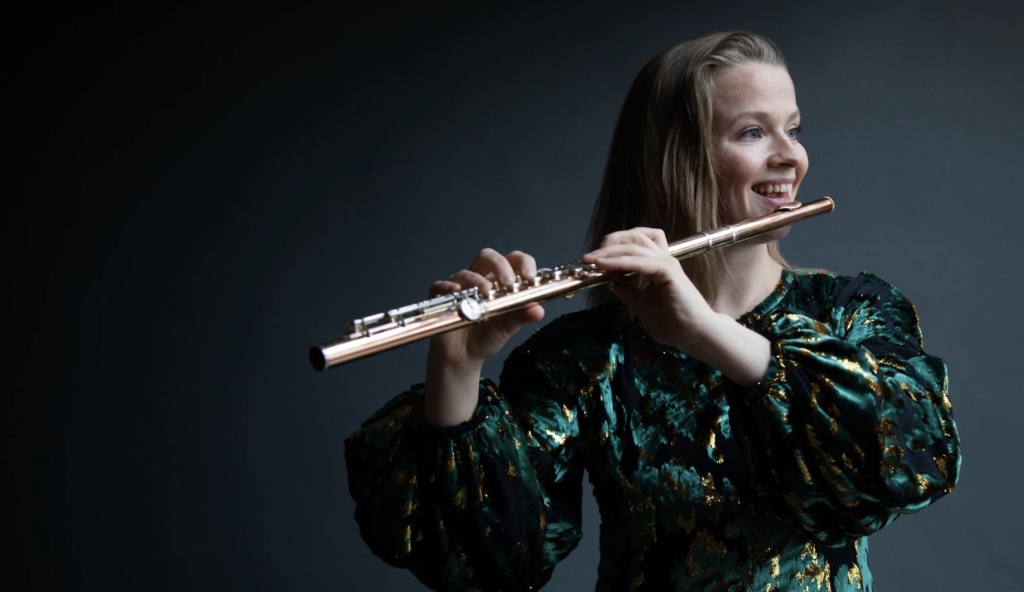
Iceland Flute Music & Björg Brjánsdóttir
Could you provide a short characteristic of Icelandic musical culture—some interesting facts, including when compositions for the flute first appeared?
I am very proud of the strong and ambitious music education we have in Iceland. I hope that future politicians will continue to protect and take care of this important aspect of cultural life. Iceland also feels like a very special place where it comes to new music and creativity. Composers and performers have always taken on many different roles at once to make things happen – probably because of our small population – and this often creates something unique and exciting.
Up until recently, not a lot of music for flute was written and published in Iceland. The first piece for flute published in Iceland I could find is from 1965. This changed dramatically in 1968 when the flutist Robert Aitken first came to Iceland. This was the first of what would end up being 26 visits! He started working with composers and inspired many to write for the instrument, so he was a huge influence on the flute repertoire.
You can’t really talk about the flute culture in Iceland without mentioning the enormous impact that Manuela Wiesler had on the Icelandic music scene and especially flute playing. Manuela lived in Iceland from 1973 to 1983 and composers wrote many pieces for her. She inspired many composers and flutists by collaborating with them, performing their works and teaching. Another important teacher in Iceland is Bernharður Wilkinsson, who now lives in the Faroe Islands but lived in Iceland for many years. He was the principal flute in the Iceland Symphony Orchestra (ISO) and taught a whole generation of Icelandic flutists (for example Stefán Ragnar Höskuldsson). He still participates in the Icelandic music scene, for example he has been a regular guest conductor with ISO. In the year 2022 he conducted the memorial concert for Hallfríður Ólafsdóttir that was organized by the Icelandic flute choir.
Hallfríður was my teacher for 10 years and was also an important figure in the Icelandic flute scene. She was the principal flute of ISO and teacher of many. She organized multiple flute masterclasses with internationally acclaimed flutists such as Emily Beynon, Ian Clarke and William Bennett. This proved influential to the younger generation of flute players in Iceland. She was also the author of the children’s book called Maximus Musicus, which has been translated into many languages and presented by numerous orchestras around the world.
What are/were your artistic activities and projects?
These days I am finishing a contract in the Symphony Orchestra of Norrlandsoperan in Sweden where I have been playing for the last two months. I am also putting the finishing touches on a score I composed for an Austrian short film production. The next big projects on my agendaare with viibra (my flute septet) at the Reykjavik Art Festival, with my chamber orchestra Elja. Later this fall I am releasing my second solo album, Knega This CD contains five new pieces for solo flute that I commissioned and workshoped with the composers.
Another exciting project next season will be at Deutsche Oper in Berlin in January and February 2027. My friend and long time collaborator Bára Gísladóttir is composing a new opera that will be premiered in January 2027 and I will play a solo flute part in the opera.
Can you describe the role and activities of the flute society in Iceland, if exists? Additionally, what can you tell us about the international Icelandic events organized for flutists?
The Icelandic Flute Choir was founded in 2003 and was for many years very active in the Icelandic music scene, premiering new works for flute ensembles and organizing concert series. They performed at the NFA conference in New York in 2009. I remember this clearly as I was around 16 years old and found the thought of a flute conference beyond exciting! Recently, other smaller flute ensembles have emerged, such as Aulos flute ensemble and viibra flute septet. Both of these ensembles perform mainly contemporary works and collaborate with composers. Additionally, viibra toured the world with the singer Björk from 2018 until 2023 which I think of as an international representation of icelandic flute playing! There haven’t been many big international flute events in Iceland that I know of, although some of the flute teachers in Iceland have organized ambitious masterclasses with international flutists for Icelandic flute students. A good example of how ambitious music teachers in Iceland are!
Could you tell us a few words about famous flutists from Iceland ?
Our biggest superstar is without a doubt Stefán Ragnar Höskuldsson, who has newly been appointed the principal flute of Berlin Philharmonic Orchestra and previously was a member of the Chicago Symphony Orchestra and the Metropolitan Opera Orchestra. If you haven’t listened to him already, you should!
Which compositions by Icelandic composers would you suggest flutists learn and perform?
There are many composers I would recommend, but Atli Heimir Sveinsson’s Sounding Minutes is a classic. There are in total 21 movements of 1 minute each but you are free to choose your own combination and amount of minutes! Another classic is Þorkell Sigurbjörnsson’s “Columbine”, a flute concerto written for Manuela Wiesler. The second movement is a beautiful sicilienne and is often performed on its own.
One of my favourite newer Icelandic flute albums is Ethereality, an album of solo flute works performed by my friend and colleague Berglind María Tómasdóttir. There are some interesting solo works worth checking out!
I also have to mention the solo pieces that my friend Bára Gísladóttir wrote for me if someone is up for a different kind of challenge! Her works are published and available for purchase at Edition S. The pieces are all on the album GROWL POWER, one for piccolo, one for flute, one for alto flute and on for bass flute.
I also would strongly recommend taking a look at the Sheet Music Collection at the Iceland Music website. There is a good database of most of the Icelandic works written for flute (and written in general!).
Are there flutists cooperating with composers and ordering new pieces?
Yes. I would say that the collaboration with composers in Iceland in general is very fruitful and flutists are quite active in the contemporary scene. The flute ensembles already mentioned have a long list of successful cooperations along with different solo projects of flutists.
Can you tell us something about new compositions by Icelandic composers for flute?
The new compositions closest to my heart are the ones I am recording in the near future, works by Páll Ragnar Pálsson, Veronique Vaka and Kolbeinn Bjarnason. They were all commissioned and premiered by me in the last years. Páll’s and Veronique’s works (“Svif” and “Magnesia”) are available at Universal Edition and Kolbeinn’s work “Nocturnes” will be Iceland’s contribution at the ISCM (International Society for Contemporary Music) festival in Romania now in May.