Beyond the Stage: Rethinking the Modern Musician
By Zhanar Abay
September at the Musician Entrepreneurs Club: Solo Careers, International Experience, Professional Connections, Money, and Independent Projects
What happens to a musician after earning a prestigious education, winning international competitions, and entering the professional stage?
In classical music education, the answer often seems obvious: continue refining your performance skills. But today’s professional reality raises many more questions for musicians.
Where do we find opportunities? How do we create our own projects? How do we talk about money? How do we build professional relationships? And can we remain in music while developing other professional directions at the same time?
These questions formed the foundation of the September program at the Musician Entrepreneurs Club (MEC).
MEC Special Guest — Yerzhan Kushanov
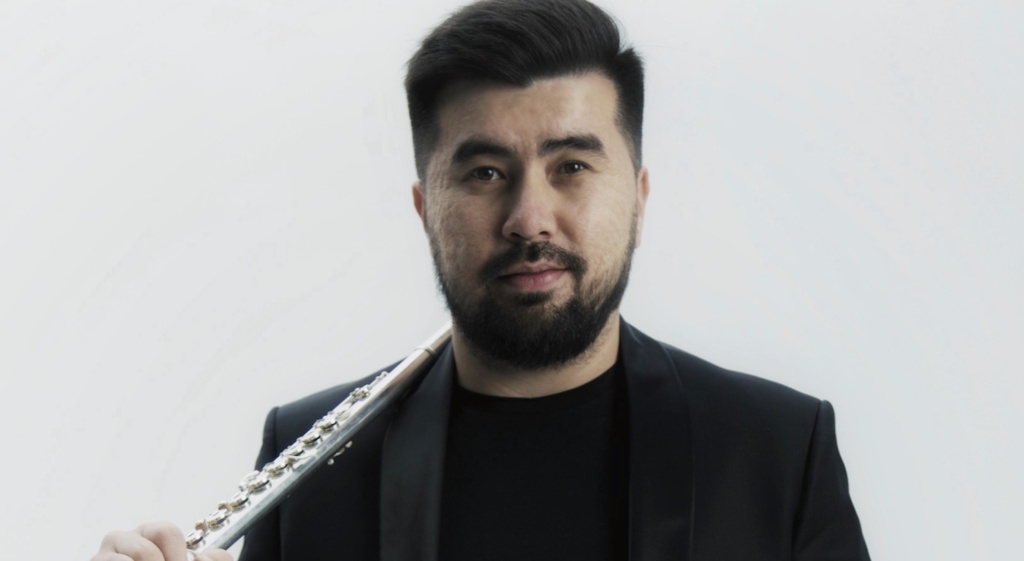
The central event of the month was a conversation with Yerzhan Kushanov, a Kazakh flutist, internationally performing musician, educator, and project creator.
Yerzhan’s professional path represents the kind of academic trajectory that many young musicians in Kazakhstan aspire to.
He continued his studies at the Conservatoire National Supérieur de Musique et de Danse de Paris (CNSMDP), where he studied with Pierre Dumail. At the Paris Conservatoire, he earned his Licence and Master de Musique degrees and was awarded the Premier Prix CNSMDP, receiving high marks from the jury.
His performing career has taken him both across Kazakhstan and onto the international music scene. His professional experience includes work with the State Academic Symphony Orchestra of the Republic of Kazakhstan, the Zhambyl State Philharmonic, and the Gothenburg Symphony Orchestra in Sweden, as well as collaborations with ensembles such as the Orchestre de Paris, Orchestre National Montpellier Occitanie, Barcelona Symphony Orchestra, Oper Frankfurt, and Orchestre d’Avignon.
Alongside his orchestral and solo work, Yerzhan has developed his teaching practice, working with young musicians and giving masterclasses.
But it was the combination of his performing career and entrepreneurial experience that became the main reason for our conversation.
Yerzhan shared that his interest in entrepreneurship began when he was still young. He started reading books about business and exploring different directions. His experience taught him that professional development does not always follow a straight line, and that the lessons gained along the way can become part of a musician’s broader professional experience.
This was one of the aspects I found particularly interesting. In the professional music world, we often see the finished result: education, competitions, concerts, positions, projects. When we compare ourselves as beginners to professionals who have already established themselves, we can easily overlook how much work, persistence, and self-discipline stand behind those results.
For me, it was especially important that this was not a formal conversation about success, but an open professional dialogue about finding one’s own path, entrepreneurship, opportunities, and how different experiences ultimately become part of both professional and personal growth.
Does a Musician Have to Move Away from Classical Music to Make Money?
One of the questions I wanted to ask Yerzhan concerned a fairly common perception of a musical career in Kazakhstan.
Does an academic musician really have to move toward pop music, soundtracks, or even leave music for another kind of business in order to earn a good income?
Yerzhan’s answer struck me as particularly important.
In his view, the first thing to consider is how a particular direction feels to you personally and whether it genuinely resonates with you.
In other words, simply wanting to earn money does not mean that a musician has to force themselves to do something that does not inspire them at all.
It is a simple idea, but for musicians, it can be a fundamental one.
We often think of a professional career as a matter of adapting ourselves to a particular market: if something makes money, then that is what we should do. But what happens when, in the process, we gradually lose our connection to the reason we chose music in the first place?
Yerzhan pointed out something interesting: when a person chooses to stay true to themselves and to what genuinely matters to them, new opportunities may begin to appear—opportunities they simply could not see before.
And this is where entrepreneurship stops looking like an attempt to monetize a musical education at any cost.
Instead, it becomes a way of finding your own path.
Where Do You Start If You Want More Professional Freedom and Income?
When asked where a musician should begin if they want to expand their professional opportunities, Yerzhan emphasized the need to develop additional skills.
And he highlighted one in particular: networking.
Talk to people. Meet new people. Expand your professional circle. Don’t remain within the same familiar network.
Because new opportunities often come through new people.
This idea connected naturally with the next September meeting at MEC — Musician Networking: 10 Unspoken Rules of Professional Communication.
For me, the subject of networking is also closely connected to my own experience.
During my professional internship in the United States, I became particularly aware of how important the way we communicate is within a professional environment.
When I began meeting and talking with colleagues, I suddenly thought of Dale Carnegie’s book How to Win Friends and Influence People, which I had read some time before.
The people around me seemed to communicate according to many of the principles described in that book. They showed genuine interest in the person they were speaking with, listened attentively, asked questions, and easily kept a conversation going.
And the most interesting part was that they were genuinely pleasant to talk to.
For me, this became an important professional observation.
Musicians often think about their careers in a particular way: if I play better, practice more, and continue improving my level, people will notice me, invite me, and offer me opportunities.
And I absolutely do not want to diminish that.
A high level of performance is the foundation.
But my own experience has shown me that many opportunities came to me precisely through conversation.
They came at moments when I could not physically pick up my instrument and demonstrate my professional level.
Over a cup of coffee. In a conversation. At a meeting. While getting to know someone.
And that makes me look at the idea of professional competence somewhat differently.
Sometimes an opportunity appears not when you are performing, but when someone is talking to you.
And How Much Is What We Do Worth?
Another September topic at MEC was “Value and Money: How Much Is My Work Worth?”
We talked about why musicians often find it difficult to name a price for a lesson, performance, or project.
I encouraged the club members to look at this issue from a slightly different perspective.
When a musician names a price for a performance or a lesson, they are not simply selling an hour of their time.
That hour represents years.
Education. Competitions. Masterclasses. Concerts. Rehearsals. Thousands of hours of practice. Mistakes. Victories. Losses. Experience working with students and colleagues. Professional decisions that can now be made in a matter of minutes precisely because they are backed by years of accumulated experience.
When we say “one hour of a lesson,” we see only that one hour.
But the client receives the result of all the years that came before it.
I believe this is one of the important internal shifts a musician needs to make in order to develop a different relationship with the value of their own professional work.
From Opportunities to Independent Projects
The final September meeting will focus on another important step:
“I Want to Create My Own Projects”: How Musicians Can Work Legally and with Confidence
When a musician begins teaching independently, creating courses, organizing masterclasses, launching their own projects, or accepting payment for their work, new questions arise—questions that go beyond the creative side of the work.
How should everything be structured properly? How should payments be handled? What kinds of contracts are needed? What should a musician consider when beginning to work independently?
For MEC, this is a natural continuation of the September theme.
First, we talk about what a musician wants to do.
Then — who they can do it with and how to find those people.
Then — how much their work is worth.
And finally — how to turn an idea into a real project.
All of these topics are connected by one idea:
A modern musical career does not necessarily have to exist only within an established system.
A musician can remain a performer while also being an educator, project creator, organizer, consultant, or entrepreneur. They can combine several roles without giving up their core professional identity — and begin to explore what else is possible for a musician beyond performance.
1Zhanar Abay
Flutist • Educator • Music Researcher
Founder, Musician Entrepreneurs Club (MEC)