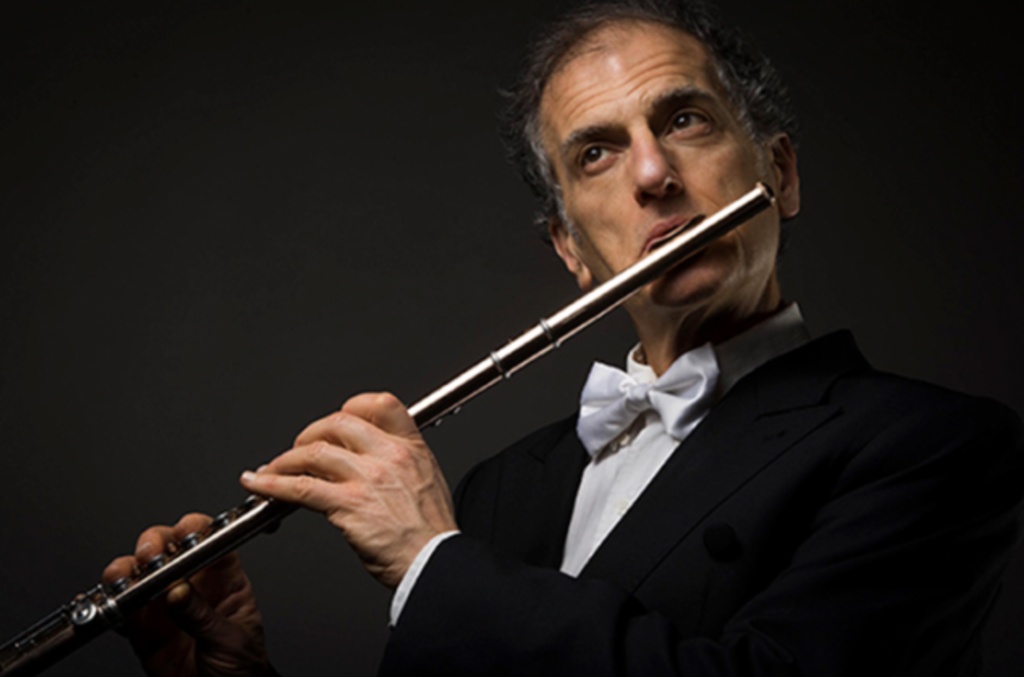
Claudio Barile: A Life in Music, A Legacy at Teatro Colón
Celebrating an extraordinary career, a lifetime of artistry, and the retirement of one of Argentina’s distinguished flutists
There are musicians whose careers are measured not only in concerts, recordings, awards, or the number of years they have occupied a position, but in the generations of musicians and audiences they have inspired. Claudio Barile is one of those musicians.
After decades of performing on the world’s stages and serving as Principal Flute of the Buenos Aires Philharmonic at the legendary Teatro Colón, Barile is now entering a new chapter as he retires from his orchestral position. His departure marks the close of an important era—not only for the orchestra, but for Argentina’s flute community and for the rich musical tradition he has represented throughout an extraordinary career.
Born in Buenos Aires, Claudio Barile has devoted his life to music while carrying the artistic spirit of Argentina with him around the world. His career has taken him from the great concert halls of South America to Europe and the United States, establishing him as one of the most respected Argentine flutists of his generation.
A Lifetime at Teatro Colón
Barile joined the orchestra of the Buenos Aires Philharmonic in 1974 and, beginning in 1984, served as its Principal Flute and soloist. For decades, his sound was part of the musical identity of one of the world's great opera houses and concert venues.
Teatro Colón occupies a unique place in the international musical landscape. To hold a principal position there for so many years is an extraordinary accomplishment, requiring not only exceptional musicianship, but consistency, versatility, endurance, and an ability to respond to the demands of an enormous repertoire.
Throughout his tenure, Barile was frequently featured as a soloist with the orchestra, performing some of the great works of the flute repertoire. His performances have included concertos by Mozart, Jacques Ibert, and C. P. E. Bach, among many others.
For audiences entering the magnificent Teatro Colón, hearing Claudio Barile play the flute was part of the experience of hearing the orchestra itself. His artistry became woven into the musical life of Buenos Aires.
Although his career was deeply rooted in Argentina, Barile's musicianship has always been international.
He has held positions and performed with ensembles including the Buenos Aires Musical Ensemble, Mexico's Orchestra of the Americas, and the National Symphony of Argentina. His international experiences also included performing with members of the Berlin Philharmonic and participating in a recording of Brahms's Serenade No. 1 in D Major, Op. 11, conducted by the legendary Claudio Abbado.
One of the important chapters of his career was his work with Camerata Bariloche, the internationally celebrated Argentine chamber orchestra. As a member of the ensemble, Barile performed throughout Europe and the United States, including an historic appearance during the centennial celebration of Carnegie Hall in New York.
His recording of Alberto Ginastera's Impresiones de la Puna with Camerata Bariloche, released on the Dorian label, remains an important document of his artistry and of the Argentine musical tradition he has championed throughout his career.
His solo career has also included performances with the Prague-Collegium Orchestra and the Buenos Aires Bach Festival Orchestra.
For Barile, music has never been confined to the orchestral stage.
He has been an active chamber musician throughout his career, performing with the Baroque Ensemble and Quadro Barocco, exploring historically informed performances and period-instrument repertoire. He was also a founding member of the award-winning Buenos Aires Philharmonic Quintet.
In 2009, the quintet received the prestigious Konex Award for Chamber Music, adding another distinction to Barile's already remarkable list of honors.
His commitment to chamber music reflects an important dimension of his artistry: the ability to listen, communicate, and create music collaboratively. These qualities are fundamental to great orchestral playing as well, and they have undoubtedly contributed to his longevity and success as a principal orchestral musician.
Recognized Among Argentina's Musical Elite
Barile's accomplishments have been recognized repeatedly throughout his career.
He is a three-time recipient of the prestigious Konex Award, including the Platinum Award for Wind Instruments in 2009 and the Konex Award for Wind Instruments in 1999 for his accomplishments as a soloist.
His other distinctions include First Prize in the Second National Young Instrumentalist Competition in Mar del Plata; the Diplôme d'Honneur from the Young Flutists Contest organized by La Guilde Française des Artistes Solistes in Paris; a Mozarteum Argentino Scholarship from Fundación Antorchas to attend Herbert von Karajan Foundation courses in Berlin; First Prize in the Argentine Musical Competition; the OAS-CIDEM Prize from the Organization of American States in Washington, D.C.; First Prize in the Mozart Biennial Competition; and First Prize in the Argencard Competition organized by Radio Clásica.
That last award opened another significant door in his life, allowing him to participate in the 40th Aspen Music Festival and study with two legendary teachers, Nadine Asin and Sir James Galway.
His early teachers included Domingo Rulio in Buenos Aires and Karl-Heinz Zoller in Berlin, providing the foundation for an artistic journey that would eventually take him around the world.
A Lifelong Relationship with the Flute Community
Barile has also remained deeply connected to the international flute world.
He was featured as a soloist at the James Galway International Masterclass in Weggis, Switzerland, and at the National Flute Association Annual Convention in the United States. His American activities have included masterclasses, university residencies, concerts, and recording projects.
His U.S. tour included teaching at Trinity Chamber Concerts in San Francisco, a residency at Texas Tech University focused on the music of Astor Piazzolla, a performance of the Khachaturian Flute Concerto with the Ridgewood Symphony Orchestra in New Jersey, a masterclass at the Hartt College of Music, and recording sessions at Ithaca College.
These activities reveal another important aspect of Barile's legacy: he has not simply performed for audiences—he has shared his knowledge with younger generations of musicians.
Perhaps one of the most distinctive elements of Claudio Barile's career has been his commitment to Argentine music.
His artistry has been particularly associated with the music of Astor Piazzolla and with bringing Argentine musical traditions to audiences around the world.
His recording featuring Piazzolla's History of the Tango for flute and piano and Tango Etudes for solo flute, together with Daniel Binnelli's París desde aquí, received the prestigious Carlos Gardel Award for Best Classical Album in 2012.
This recognition was especially meaningful because it connected Barile's virtuosity on the flute with the musical culture of his homeland.
A New Chapter
Retirement from a position held for decades is never simply the end of a job. For an artist, it can represent the closing of a chapter of identity, routine, community, and history.
For Claudio Barile, leaving his position as Principal Flute of the Buenos Aires Philharmonic at Teatro Colón brings to a close an extraordinary orchestral journey that began more than half a century ago.
Yet retirement from an orchestra does not mean retirement from music.
The experiences, recordings, students, colleagues, performances, and audiences accumulated over such a remarkable career form a legacy that continues far beyond a final orchestral performance. Every musician who heard him, studied with him, performed beside him, or was inspired by his artistry carries a piece of that legacy forward.
And perhaps this is one of the greatest gifts an artist can leave behind.
Claudio Barile's career has been a bridge between Argentina and the world, between orchestral and chamber music, between performance and teaching, and between generations of flutists. His sound has been heard in some of the world's great halls, but his artistic voice has always remained unmistakably connected to the musical culture of Argentina.
As he steps away from his chair as Principal Flute of the Buenos Aires Philharmonic, the international flute community celebrates not simply the end of an orchestral position, but a lifetime of music.
Thank you, Claudio Barile, for the artistry, dedication, generosity, and extraordinary musical legacy you have shared with the flute world.
May this next chapter bring you the freedom to explore, perform, teach, create, and enjoy music in all the ways that have made it such an essential part of your life.