Hidden gem: Flute music by Enriko Josif
by Sanda Mašić
I was sitting in the living room in the home of my flute mechanic when I mentioned that I was looking for a dissertation topic that would make a difference and contribute to the flute world. I come from a small Eastern European country of Serbia, and I knew there have been composers who have done amazing work, but never received nearly as much attention as they deserve. While he was checking my flute, my mechanic said: Take a look at the works of Enriko Josif, he loved the flute!
I started digging and I found treasure! So many musical works for various instruments and ensembles, but not a whole lot of proof that they are performed enough, or at all! Most of the pieces for flute were still in manuscripts and that is where flutists read them and performed them from. Some of the music even had different manuscript copies, which made it challenging to determine which one is the original manuscript. Additionally, almost all the materials for the potential research were available only in Serbian, so I found that a foreign musician would not be able to do a whole lot of work, unless someone who speaks the language does some research on this first. I decided to get to work, to slowly make a clear path towards original parts, analyze them, make clean copies in a music software for notation for at least some of them, and put a spotlight on the opus of this composer which he deserves. His legacy is truly remarkable!
Enriko Josif was a Serbian composer raised in the Sephardic Jewish family. Born in 1924, his works are mostly composed close to and throughout the second half of the 20th century. His compositional influences were diverse — some of his pieces were neo-baroque in style, while some others were quite impressionist in sound and combined with the folk sounds of the Serbian origin. His flute pieces are focused on the importance of melody that sounded like a vocal line. They are composed in a very poetic way with philosophical connotation which is obvious not only in the way they sound like, but also in the names that he chose for them.
Enriko Josif composed quite a few pieces for flute! In addition to his solo and chamber works for this instrument, he composed several works for flute choir. Flute choir music by Enriko Josif is a result of his friendship and collaboration with the Serbian flutist Miodrag Azanjac, who was a leader of a flute choir at the time and who would program his music.
Flute music by Enriko Josif has been under the care of the Serbian Academy of Sciences and Arts in Belgrade since his death in 2003. The list of flute works is very rich in sound color palettes, as well as ensemble kinds and size choices.
Enriko Josif’s large opus that uses flute includes the following works:
- Lyric Symphony for four flutes, harp and string orchestra (1956)
- Visions for flute, harp and piano (1964)
- Hamlet for flute, harpsichord, harp and viola da gamba (1969)
- Inscriptions for woodwind quintet (1969)
- Ballade for flute solo (1970)
- Psalmody 1 for flute solo (1970)
- Psalmody 2 for flute solo (1970)
- Invocations for flute choir, two trumpets and harp (1978)
- Divertimento for woodwind quintet (1981)
- Signs 2 for flute, flute choir, harpsichord and cello (1987)
- Poetic Speeches for flute, flute choir and cello (1988)
- Epic Canto for flute choir and cello (1988)
- In Honor of Time for flute choir, two trumpets, trombone, 2 horns, 2 bassoons, viola and cello (year unknown)
- Largo Nobile for two flutes and harp (year unknown)
- Monody for flute and harp (year unknown)
After seeing such a rich list of flute works by Josif, I decided to do research and dedicate a big part of my dissertation to his music. In my final document, I completed his biographical information and discussion of his three pieces for solo flute: Psalmody 1, Psalmody 2 and Ballade, as well as Monody for flute and harp. Research on these pieces provides formal and motivic analysis, in addition to historical influence. For instance, Psalmody 2 was influenced by Psalm 137 from the Hebrew Bible, and its structure reflects this.
My complete dissertation containing this research is available free of charge online:
Mašić, Sanda, "A Survey of and Performance Guide to Representative Flute Music by Two Twentieth-Century Serbian Composers: Ljubica Marić and Enriko Josif" (2025). Dissertations and Doctoral Documents from University of Nebraska-Lincoln, 2023–. 292.
https://digitalcommons.unl.edu/dissunl/292
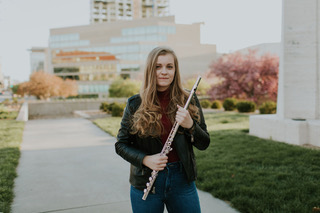
Dr. Sanda Mašić is a flutist from Serbia currently residing in the U.S. She has performed throughout Europe and the U.S. Dr. Mašić is currently working as adjunct faculty at Union Adventist University in Lincoln, Nebraska. She graduated with a Doctor of Musical Arts in flute performance from the UNL Glenn Korff School of Music this May, where she also served as a graduate teaching assistant. You can find her on Instagram.