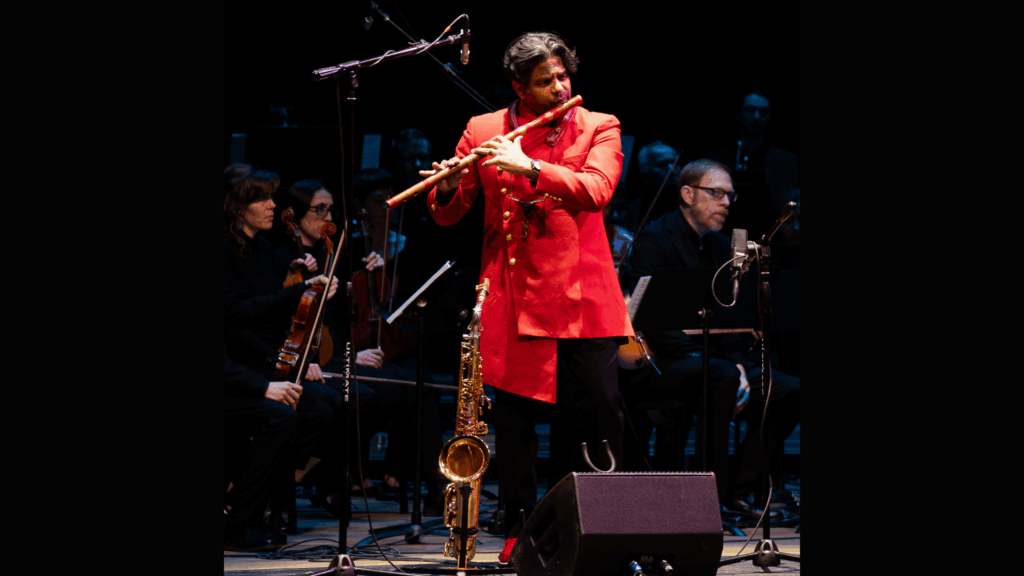
Breath, Bamboo, and Stillness: A Saxophonist’s Journey into the Bansuri
Breath, Bamboo, and Stillness: A Saxophonist’s Journey into the Bansuri
By Anjan Shah
Each morning begins the same way. I sit cross-legged on the floor, a tanpura drone humming softly in the background. I lift a piece of bamboo to my lips, close my eyes, and exhale. The first sound is almost always imperfect—airy, unstable, fragile. But within minutes, something shifts. The tone centers, my breath deepens, and the mind begins to quiet. For the next two hours, I’m not “practicing” in the way I used to as a saxophonist. I’m meditating through sound.
I’ve spent most of my life behind a saxophone—performing, teaching, and exploring music through the lenses of jazz and Western classical traditions. The saxophone rewards control and projection; its sound commands attention. The bansuri, India’s bamboo flute, asks for something different. It rewards surrender. I came to it later in life, not out of professional necessity, but through a deeper and more personal calling—one that began with loss.
When my father passed away, I found myself reflecting on the parts of my heritage I had kept at arm’s length. My father had always encouraged me to learn Hindustani music when I was young, but I was too consumed with scales, sonatas, and jazz harmony to listen. After his passing, I felt an urge to reconnect with that side of myself—not just as a musician, but as a son. The bansuri became my bridge between worlds. It offered me a way to reconcile the Western musical training that shaped me with the Indian musical traditions that shaped him.
The instrument itself is astonishingly simple: a hollow piece of bamboo with six or seven holes. Yet its sound carries centuries of lineage, emotion, and spiritual depth. The first time I heard it live, the tone felt both ancient and intimate—an unbroken breath linking past and present. I wanted to understand that sound.
At first, I did what many curious learners do in the digital age: I turned to YouTube. I watched tutorial after tutorial, trying to imitate the fingerings and alankars (melodic patterns) of teachers half a world away. It was humbling to start again after decades of fluency on the saxophone. But there was a kind of freedom in that humility. For once, I wasn’t chasing mastery—I was rediscovering curiosity.
Eventually, my search led me to Deepak Ram, a brilliant flutist who studied under the legendary Pandit Hariprasad Chaurasia. Deepak’s artistry bridges the worlds of Hindustani music, jazz, and improvisation—worlds I, too, inhabit. Studying with him transformed my understanding of sound. His lessons often began not with scales or exercises but with a single phrase: “Play as if you’re exhaling your thoughts.” That one idea changed everything about how I approached tone, breath, and expression.
A vital part of my daily practice now is playing against a drone—usually a shruti box or tanpura app. Many flutists think of drones as tuning references, but for me, they’re much more. The drone creates a living sonic space—an aural horizon that invites stillness. Over time, it becomes less about pitch accuracy and more about mental alignment. The longer I sit with the drone, the quieter my thoughts become. Two hours can feel like two minutes when breath and sound merge into one continuous meditation.
This practice has refined more than my tone; it has reshaped how I listen—to sound, to silence, to myself. It’s also transformed my saxophone playing. The bansuri’s emphasis on meend (gliding between notes) has softened my phrasing. The concept of swar—the living quality of each pitch—has made me more attuned to nuance and resonance.
For flutists reading this, my story isn’t about “doubling.” It’s about returning to the source of sound itself. The bansuri taught me that tone is not something we produce—it’s something we uncover through breath and stillness.
Each morning, as I lift the bamboo to my lips, I feel both my father’s absence and his presence. The air that moves through the flute feels like a conversation we’re still having—a dialogue between tradition and discovery, between the known and the eternal. And in that breath, I find peace.
 About the Author
Anjan Shah is a saxophonist, bansuri player, and marketing strategist whose work bridges jazz, Western classical, and Hindustani traditions. A former soloist with the U.S. Army Field Band, he is the founder of the Temporal Taal Collective, an ensemble known for its cross-cultural collaborations with orchestras such as the Charlotte and Hopkins Symphonies. Anjan is currently completing his Master of Music degree at the University of Illinois, where his studies in performance and musicology inform his creative path. His daily bansuri practice—of breath, tone, and stillness—serves as both meditation and artistic renewal.