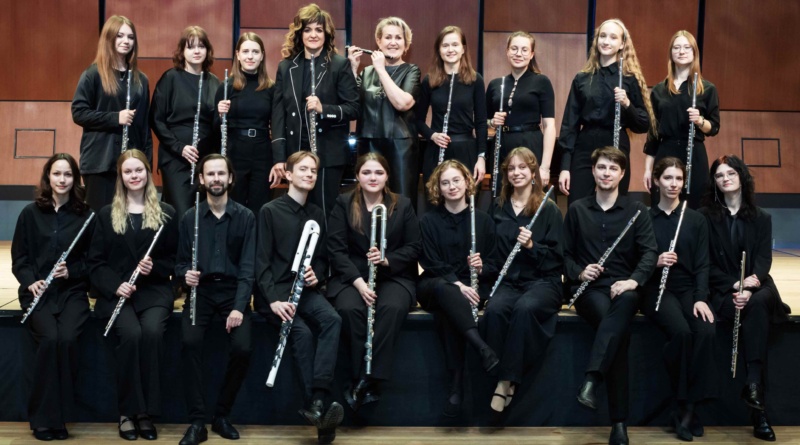
Spotlight on The Moscow Flute Orchestra
The Moscow Flute Orchestra is a unique creative ensemble, the first professional flute orchestra in Russia. Its members include outstanding and talented musicians, including a new generation of Moscow flutists, graduates and students from the Tchaikovsky Moscow State Conservatory, the Gnessin Russian Academy of Music, and other leading educational institutions. The orchestra was founded in 2025. The ensemble quickly gained public attention and has already established itself as an innovative project that reveals the rich timbres and colors of this refined instrument. The orchestra's concert programs include masterpieces of world classical music, from Baroque to contemporary composers. The Moscow Flute Orchestra was Founded by Natalia Osipova and the Artistic Director.
How did you decide to create the Moscow Flute Orchestra?
I've long harbored the idea of founding an orchestra, as I love my instrument very much. I believe a flute orchestra has its own unique sound, an incredible variety of timbres, from the high piccolo to the rich baritone and bass registers, opening up limitless new possibilities for musical creativity. In Russia, such an ensemble had never existed before, with the exception of student flute orchestras.
One day, my closest friends and fellow flutists and I decided to pursue our dream. It wasn't easy, as we all work in different professional organizations—symphony orchestras and educational institutions—and our free time was limited. But we found the time and energy to create our ensemble, taking advantage of every opportunity to learn new works, achieve our own balanced sound, and present a completely new product to the public. The orchestra was founded in 2025.
I'm a teacher, so there's a certain intergenerational continuity in our orchestra: it includes adult professional musicians and my students, graduates who are still developing their professional skills.
What is your goal with this ensemble?
Our goal is to allow the public to hear masterpieces of world classical music in a new and unusual sound, to popularize our beautiful instrument, and to showcase the flute's boundless expressive and virtuosic potential! The ensemble has quickly gained the public's attention and has already established itself as an innovative project.
How often do you rehearse?
We rehearse once a week, but we can meet more frequently before concerts.
It seems there's no conductor. How are rehearsals going? As the group's founder, are you also its main "leader"?
I, Natalia Osipova, am the orchestra's founder and artistic director. I am a professional flutist, winner of the Russian Ministry of Culture award, teacher, author of teaching manuals for flute performance, and winner of national and international competitions as a soloist. During rehearsals, I act as conductor, and we meticulously work on each part—the orchestra's voice—creating a harmonic and rhythmic texture. We perform some works without conducting, but more complex symphonic works are performed with a conductor, such as Claude Saint-Saëns's "Carnival of the Animals," Shostakovich's "Swan Lake" suite, and the "Festive Overture" by Shostakovich. This means that I sometimes conduct at concerts.
What's the current state of the Moscow flute scene? Are there any flute festivals? Competitions? Or composers writing for flute or flute ensembles?
The flute is a very popular instrument in Russia, and the Moscow flute school is actively developing. We have many wonderful professional flutists and teachers, true enthusiasts and masters of their craft. Moscow hosts various flute competitions and festivals, such as the "Golden Flute of Russia" competition, which I organize. This competition is interesting because it brings together students from different regions of the country, participants of various ages from 7 to 21, and students from professional educational institutions. The competition has its own unique mandatory program, developed specifically for each competition, as well as a valuable prize fund. Moscow also has a number of composers who actively write music for our wonderful instrument, both solo and for ensembles of various sizes.
What were three key moments that played a decisive role in your development as an artist?
As a child, in music class at my public school, I heard Prokofiev's symphonic fairy tale "Peter and the Wolf," in which the bird was played by a flute. I was so impressed by the instrument's sound and virtuosity that I immediately wanted to learn to play it and never parted with it. This passion eventually became my profession and my life.
The second important aspect is a boundless inner drive for self-improvement and learning new things, which helps me inspire others and serve as a role model for young musicians.
The third aspect is the desire to develop the flute school and take it to a new level.
What do you enjoy most about performing?
Communicating with the audience and exchanging energy with them. Performances foster a dialogue with the audience, where the performer acts as a flexible storyteller, sharing their impressions and emotions while performing a piece of music. The audience listens and reacts vividly, absorbing musical thoughts and feelings through the artist's performance, and in return, sharing their energy. A true creative synergy emerges—inspiration and ideas unite to achieve a common goal—creating a work of art.
What is your schedule for the next six months?
We plan to perform the orchestra's new concert program, "Classical Masterpieces and New Facets," featuring works by composers such as P. I. Tchaikovsky, D. Shostakovich, G. Rutter, A. Dvorak, D. Chark, and others, at various concert venues in Moscow and other Russian cities. We also plan to perform on television and radio.
What are your personal goals? Professional ones?
My personal and professional goals coincide: touring the world with the Moscow Flute Orchestra, expanding our repertoire, meeting and connecting with friends and colleagues from different countries, and sharing my art with as many people as possible!
What inspires you most in life?
What inspires me most is the opportunity to fill the world with new colors, to share new knowledge, to teach professional skills to young musicians, to discover new horizons, to dream and make dreams come true. I am inspired by the opportunity to pursue my professional career, as the world of music is so multifaceted: performing as a solo artist with new programs, playing in various ensembles with colleagues, performing at various concert venues with the flute orchestra, teaching, conducting master classes, organizing and running competitions, creative schools, and much more.
What has been your greatest professional challenge?
Learn to convey all your thoughts and ideas to an audience during performances, and learn to translate everything conceived in musical notation into sound.
Can you give us 5 quirky, secret, fun, (don't think too much about this) hobbies or passions?
I love sports in all their forms, cars, building Lego and puzzles, books, and traveling around the world. We have a whole group of table tennis flutists; we get together and let off some musical steam.
What three pieces of advice would you give to a young flutist?
Never give up and believe in yourself, truly love what you do, and seek and find endless sources of inspiration in the art of music.
Moscow Flute Ensemble:
Founder and Artistic Director: Natalia Osipova
The orchestra’s members are laureates of many international competitions: Vasilisa Kurakina, Elena Krivorotova, Aksinya Khomenko, Evgeniya Koroleva, Olga Lutsenko, Feoktista Miroshkina, Nikolai Khazanov, Anna Bryosova, Ivan Sobolev, Tatiana Stanilovskaya, Maria Telepneva, Natalia Stashkevich, Ilya Osenev, Andrey Vladimirov, Ksenia Sukhova, Maria Skalina, Anastasia Markova, Ksenia Rudenko, Uliana Leontieva, Anna Makhova, Alena Panova
Aigul Bukharova (piano)