Using F. M. Alexander’s Methodology to Solve Finger and Cervical Dystonia
by Mark Dannenbring
Mark Dannenbring maintains an active career teaching flute and body awareness (formerly) at the prestigious Tunghai University of Taiwan, while also performing regularly on both period instruments and the Grenaditte flute. He recently recorded the first CD devoted exclusively to this unique instrument, and acts as both a consultant and artist in residence for the Guo company. With his wife, Kwei-Yi, Mark has produced several Boxwood Festivals in New Zealand, a festival devoted to both Celtic music and Early music. He is also the artistic director for the Miaoli Mountain Music Festival, which explores the many traditions of both music and dance around the world. He holds a doctorate in flute performance and pedagogy from the University of Iowa, a masters from the University of Cincinnati, a diploma from the Orff Institute in Salzbug, Austria, and a B.A. from Luther College.
I spent much of my performance career with dystonia. My finger dystonia started with one middle finger and eventually affected both middle fingers over a 17 year period. I finally found a solution in 2006, and the fingers never had a relapse. Unfortunately, by 2010 a cervical dystonia was becoming apparent along with a vocal dysphonia. And the challenges of the cervical dystonia has once again given me another challenge until recently.
At present I only have the vocal dysphonia to solve. Many would consider my recoveries to border on miracles, as the medical world says there are no lasting cures, only remissions. But I am challenging that statement after being free from any finger dystonia for so long. And I am quite sure my brain has also found a way to circumvent faulty neural pathways and create new neural connections to overcome the cervical dystonia. I have only been out of the cervical dystonia for less than a month, but after going through my many years of finger problems I can project that my body feels completely balanced for the first time in 15 years.
Dystonia affects the basal ganglia, cerebellum, and motor cortex disrupting the balance between excitatory and inhibitory neural signals. The neurological disorder is characterised by involuntary muscle contractions, leading to abnormal postures and impaired motor function. In the case of the fingers, I could not control one middle finger from sticking straight up or the other from pulling downward. But the fingers only caused problems when playing flutes. The cervical dystonia affected the head being pulled right by the neck and the inability to turn it to the left. Obviously playing transverse flutes were a problem, because it requires some left turning to play any of them except perhaps a piccolo. Furthermore, it affected all normal motion. I could not see straight ahead. Walking would also pull my body towards the right. And if I attempted to resist the pull I got even more twisted. But I never lost hope of finding an answer. If my brain could make the necessary new connections to regain my finger coordination, why couldn’t the same happen for the cervical dystonia. I just needed a great deal of patience as I had already experienced during the first dystonia and apply my knowledge gained in decades of using Alexander Technique to find a solution.
Looking back at how my brain has possibly re-wired neural connections to resolve both finger and cervical dystonia, I do think some aspects of past learning came into play. I have always leaned towards an awareness of senses more than the cognitive side. Having spent much of my life in performing arts: dance, theatre, and musical performance, there is a greater emphasis towards feeling rather than the thought process. Dance especially requires a kinaesthetic sense to create the movement expression. But in any performing situation thinking is not part of the equation. The senses are an immediate awareness, happening in the present, and that is the goal of all performers, to share emotional stories with audiences.
The introduction of the Alexander Technique by Alex Murray when I was 21 not only gave me greater awareness of how to move, but also two tools used by F.M. Alexander to solve his own vocal problems: the power of observation and use of inhibition. By using mirrors to observe in detail how he moved when he spoke, he observed his natural inclination of movement that created his vocal problems. Due to that being his ingrained way of moving he needed to inhibit the urge to move while projecting a new direction that would alleviate his vocal problem.
There is a tendency in all of us to attempt to fix a problem by approaching it head on. This can especially be the case of people with dystonia. Unfortunately, such an approach and the anxiety that it produces results in even greater tension to the area of the dystonia. Knowing what I already had learned from decades of studying and practicing Alexander Technique, I chose not to act thus inhibiting my natural urge to play in a normal way. In the earlier case of my finger dystonia, I would find different fingers that negated the use of the dystonic finger. My left middle finger would stick straight up if I used it, so I mentally cut off that finger and used my ring finger on the A key and the little finger on the G. I could not play G# so I negated literature that required that note. It still allowed me to play a good deal of literature comfortably. I waited for a sign that might allow me to return to my regular fingering.
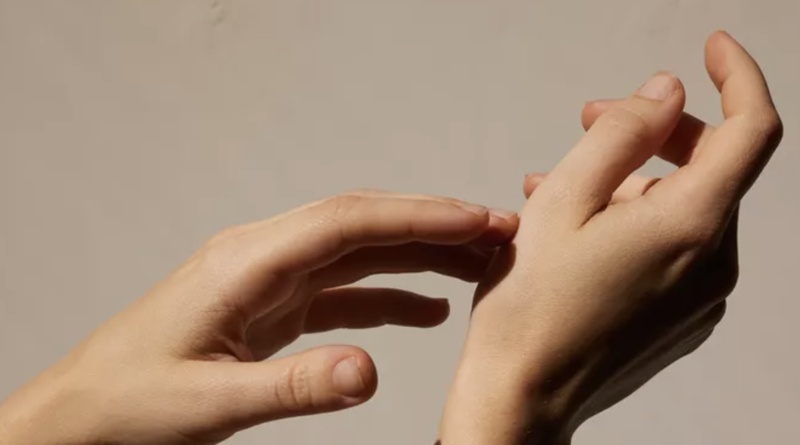
I became aware that my left finger dystonia only caused problems when playing flutes, but had no understanding of how to assimilate the middle finger with the rest of the fingers. I did turn to dreams at night to see if I might find an answer while asleep. Eventually one night with an especially vivid dream I went to the flute, and the finger had dropped. It was at least the beginning of change, though I still did not push for a change in my practice yet. I had noticed that my tactile sense felt off when attempting any use of the middle fingers on both hands. While looking for an answer I realised the top of the hand felt balanced. Only the tactile sense of the two middle finger tips created spasticity. I did spend a number of more years using metal and plastic fingers to go over my regular hand to try to guide motion from above. It never really solved the problem but they did give me enough sensation to perform most flute works. Eventually it was condensed to a single band on the left middle finger. As I stated in an earlier article written for Flute Focus, 2008, reprinted in The Flute View, 2014, I returned to my original question as to why I could not sense balance to the fingers. The answer came fast. It doesn’t feel right! So I masked my tactile sense by placing thick, nonporous tape over the tips of the dystonic fingers. Within three weeks I came out of the dystonia.
My cervical dystonia proved a greater challenge. My neck started pulling the head towards the right in 2010. I had a strong feeling that either I had a new dystonia or perhaps the same area of the brain had shifted to affect the neck area. Either way I was stuck with a new problem, and I could no longer use the tactile sense to get out of it. My last performance on a transverse flute playing on the right side took place at the NFA Convention of 2012. To get through two major performances, I stuck my head in a grand piano to guide the head to the left side with a good result. But I recognized forcing the head into a position would likely cause greater problems, so I quit the regular position of playing on the right and stopped playing most of my flutes. I needed to find a temporary solution while waiting for some sign as I did for my fingers. Why not develop a vertical head?
Geoffrey Guo, my flute maker on collaborations, and I began working on a vertical design that would allow me to rest the flute on my right thigh while playing my Grenaditte flute, a flute we had designed somewhat earlier. The response was not great nor the sound, but it did give me freedom to perform all works for flute in a very relaxed manner. (We are still working to improve this vertical head as it would be a better position for all western flutists.) I ended up playing many performances on the vertical flute while still hoping some future moment might give an indication that my brain could solve the cervical dystonia.
In the meantime, I had retired from my position in Taiwan and returned to New Zealand, my permanent residence. I decided the one instrument that required no turning of the head would be the baroque piccolo. I have always played whistle tones as warmups, highly recommended by George Barrere, principal of the NYP in the early Twentieth Century. A whistle tone is less air than a sound, only requiring a slight whisp of energy. It is the exact placement of the lips and inner mouth for each specific note of the first octave. It requires a very calm approach to releasing one’s energy and a precise inner hearing of the pitch to be produced. If a flutist can perfect the whistles, the tone will be centred once the tongue releases the air.
With plenty of time on my hands, I decided to extend the exercises of whistle tones greatly. I not only played all scales with whistles but also small songs, like hymns and folk melodies. In addition I would practice scales or arpeggios without moving any fingers. This practice would be followed by playing the same melodies and exercises with sound. I also turned my one-keyed flutes to the left side so I could use more instruments. Eventually I started tackling baroque flute works on the piccolo in addition to still using my vertical head when I wanted to have time to refresh my fingers with more difficult technique. The whistles tones on all the flutes amounted to hundreds of hours over nearly ten years. I always felt a desire to play what I could without forcing my head to the left.
Finally, two months ago I received a sign as I had when my finger dropped years earlier. At the banquet of my elder daughter’s marriage, Noelle, she asked me for a dance. Even with my concern for my twisted body I had to accept her request. To my surprise everyone said they could tell no sign of my disability. Photos taken showed me in an erect position with shoulders level, no pulling to the right. That short dance was a very quick remission of my dystonia reminding me that the problem lies in the neural pathway rather than a physical defect. For the next month I would get indications that perhaps my brain was once again finding new neural pathways to circumvent the defected connections. Finally when I awoke on June 6, I knew the dystonia was gone. I felt balanced and free. My head could finally turn left again.
I am back to playing all flutes on my right side, though it might require a month or two for my lips to readjust to the regular position after so many years of playing in awkward positions. I do have as strong a sense as when I came through the finger dystonia that my present condition is not a remission. I have had no finger problems for almost 20 years.
I never wanted to rely on taking botox or therapies to mask the dystonia. And the few times I visited a neurologist or therapist gave me an indication few if any really had answers to cure a dystonia. It was suggested to me once I came through my finger dystonia that I might have found a way to re-wire neural pathways to find a permanent solution. That comment with my own discoveries told me one needs to look within to find an answer. And that starts with observation and inhibiting past actions.
My caution to anyone suffering this disability is don’t look for a quick fix. You need a great deal of patience and self awareness both through observation and kinaesthetic awareness. Look for the tiniest clues that something might be changing but don’t jump to any conclusions. Above all else maintain a positive attitude. Our brain has great plasticity, and you can beat the odds with persistency and creative choices.